




Alysa Taylor (Mktg’97)
What do mixtapes, sewing machines and quantum computing have in common? Microsoft CMO Alysa Taylor brought them all into a lively presentation at Leeds spanning lessons learned, a changing work world and what comes next.

After her keynote presentation to Leeds’ board members in early October 2026, Alysa Taylor (Mktg’97) was looking forward to connecting with her longtime CU Boulder friend’s daughter, now a first-year student at CU Boulder.
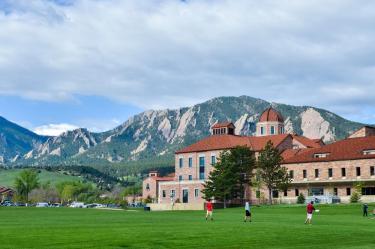
“It’s been so fun to be back,” Taylor said as she walked to the fourth-floor balcony of the Koelbel Building, admiring the timeless backdrop of the Flatirons.
It had been a busy morning. Taylor fielded numerous questions from fellow alumni after her presentation, which began by looking back at how dramatically business, technology and life had changed in the nearly 30 years since she was a student at Leeds.
Throughout Taylor’s 22-year career at Microsoft, where she is now chief marketing officer for Commercial Cloud and AI, the lessons learned at Leeds have remained an anchor. So have the friends she made during her CU days—a reminder, she said, of how much our connections shape us. Another lasting takeaway was the value of teamwork and understanding what it takes for successful teams to work toward shared goals and outcomes.
“We did so much project-based work at Leeds, and I actually remember sort of being like, ‘Well, I could just do this myself,’” she remarked, garnering laughter from the audience. But she found working through diverse perspectives proved invaluable. Learning how to work in a team environment, coupled with her minor in journalism, gave her “the communication background that has been foundational for everything that I do,” she said.
Taylor’s career path has been less about pursuing a specific job than embracing experiences along the way. She has written: “Careers aren’t meant to be a linear path upward; more often than not they zigzag up and down, through setbacks and leaps forward.”
So, what has kept her engaged?
“I always talk about knowing what gives you energy,” she said. Think less about a prescribed role or title, she advises, and more about what you are passionate about. “That is something I have followed throughout my career, and it has really been beneficial to me.”

“I always talk about knowing what gives you energy. That is something I have followed throughout my career, and it has really been beneficial to me.”
—Alysa Taylor, CMO of Commercial Cloud and AI, Microsoft
Making sense of a new revolution
Reflecting on her student days, Taylor marveled at how dramatically technology has changed and how quickly it continues to evolve. Many consider AI the beginning of a fourth industrial revolution, she noted.
“If you think about the history of every revolution, whether you start with the steam engine or the onset of electricity to the microprocessor, each one of them started with a singular invention,” she said. “Here we are today, and I would state this industrial revolution is one of the fastest we’ve ever seen in history.”
For Taylor, the question is what that revolution can accomplish. “It really comes down to how can AI transform the way that we work,” she explained.
To make those changes tangible, she turned to four analogies: the analog television, the mixtape, the sewing machine and Microsoft’s Majorana chip. One comparison was particularly fitting for a Leeds graduate of the 1990s: the mixtape.
Taylor recalled the care that went into selecting songs for someone, which was a highly personalized experience familiar to many in the room. Today, she noted, more than 70% of consumers expect that same personalization from businesses. AI makes it possible to tailor experiences at a global scale.
Her other analogies illustrated equally broad shifts: AI’s ability to cut through vast amounts of information and automate cumbersome workflows. Like the sewing machine, which dramatically reduced the time required for hand stitching without eliminating the tailor, AI can make work more efficient without removing the human touch.
“AI is able to generate new workflows and circumvent a lot of the cumbersome, manual labor that was needed to do what we used to call digital transformation,” she explained. For businesses, Taylor said, the key is starting not with the technology itself, but with the outcomes to achieve, which is where organizations can find real savings and efficiencies. She offered case studies to illustrate the point, from Children’s International boosting caseworkers’ productivity and well-being to Alaska Airlines offering personalized recommendations, to Levi’s reducing work that took a year down to a day, improving real-time inventory management.
At the other end of the spectrum, Taylor pointed to Microsoft’s Majorana chip, introduced in 2025, and the promise of quantum computing. Microsoft envisions scaling the technology to 1 million qubits on a single chip, available commercially in 2029.
“Imagine not too far in the distant future that we will be able to actually have the power of all computers in one single chip in our hands,” she said.
For Taylor, that potential matters not only for the extraordinary computing power it promises, but for its potential to address some of AI’s enormous energy demands while opening new possibilities in critical areas, including climate and disease.
Preparing for what comes next
As the mother of two teenagers, Taylor admitted it’s hard to tell them what the workplace will look like in even three to five years. That uncertainty makes continual learning and adaptability essential, she believes.
“We must have dedicated skill-building,” she said. “And it has to be intentional and embedded in the flow of learning.” The need for reinvention extends to established leaders, too. “The way I market now is fundamentally different even from a year ago,” she said.
“We must have dedicated skill-building. And it has to be intentional and embedded in the flow of learning.”
—Alysa Taylor, CMO of Commercial Cloud and AI, Microsoft
But embracing AI is about more than acquiring new skills, Taylor stressed. She said businesses, leaders and academic institutions must work together to responsibly shape what’s possible. It requires a “marriage of capabilities and commitments,” pairing what AI can do with guardrails and ethics, particularly amid concerns about cybersecurity, she said.
Taylor is optimistic that the benefits emerging for business can extend to society at large. Realizing that potential, she said, will require bringing different perspectives together to drive the technology's evolution.
“If you think about applying AI to things like climate control and curing diseases, the possibilities are really infinite. We can actually start to consider solving some of the world’s hardest challenges."
Imagine what’s possible, she posed to the audience, and then ask an essential question: “How do we elevate and use AI for good?”