


Monica Rowand (MBA’17)
Monica Rowand has spent her career betting that sports can impact sustainability faster than any grassroots campaign. A Waste360 40 Under 40 honoree, she’s spent over a decade putting that bet to work—first at Ralphie’s Green Stampede, later across pro and collegiate sports properties, and now leading the Sports & Entertainment division as a senior manager of Advisory Services at WM.

Before Leeds, you were doing grassroots environmental work in New Orleans. What sent you toward business school instead of a straight environmental degree?
My 'lightbulb moment' happened while I was doing community advocacy and environmental education for a nonprofit in New Orleans. I spent my days tabling and giving presentations to neighborhood associations, and I kept thinking: 'Imagine if the Saints told their fans about these energy efficiency programs. The impact would be massive compared to our grassroots reach.' I realized then that if you want to move the needle at scale, you have to leverage the powerful platforms.
In the spring of 2013, I was preparing to start a master’s program for environmental education and management. However, after speaking with sustainability leaders at the MLB and NHL, their advice changed my entire trajectory. They told me plainly: 'You already know the environment side. If you want to actually affect change in this industry, you have to speak our language—you have to understand business.'
Why Leeds specifically?
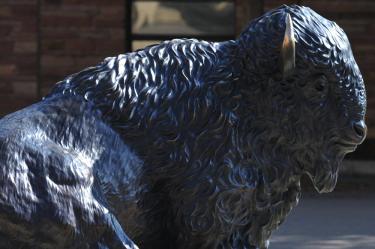
I chose the MBA at Leeds because of a unique opportunity CU could offer me. The Buffs are home of the award-winning collegiate athletics sustainability program, Ralphie's Green Stampede, founded and led at the time by Dave Newport. He told me that if I came to CU, I could work part-time at the intersection of sport and sustainability while in school. Dave and I even started a business together while I was still in school to help other organizations replicate the successes we were seeing in CU Athletics.
Was there a moment in the MBA itself that changed how you saw the problem?
The turning point for me was definitely the Social Entrepreneurship and Sustainable Venturing classes with George Deriso and Jeff York. Coming from a nonprofit background, those classes shifted my perspective by proving that I could maintain my values while operating in a world that wasn't reliant on the next grant or donation. I realized that business was just a more permanent way to solve problems.
A single game can leave a stadium with a week's worth of trash. That's a logistics problem as much as an environmental one—how did the MBA change how you approached it?
I'd like to think I understood these concepts fundamentally before coming to Leeds, but the MBA provided the specific details of how businesses and operators function. This allowed me to tie requests for sustainable change to a grounded business case. The MBA provided exposure to business considerations beyond the immediate P&L, including risk mitigation, reputation management, marketing and long-term asset value. It taught me to think more comprehensively and on a longer timescale.
Fans are there for the game, not a sustainability pitch. How do you change fan behavior without getting in the way of that?
One of the most effective ways to drive change is by making the desired action as easy and convenient as possible. In the case of choosing to recycle at a sporting event, we use system design techniques that make the choice virtually nonexistent—and operations plans to catch the rest.
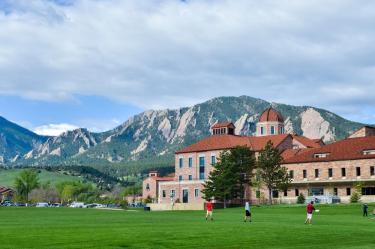
Ralphie's Green Stampede, for example, made a concerted effort to develop an identity for CU Football around sustainable waste management. It became a normalized part of the experience, to the point where tailgaters explained in one research study that while they might not recycle all the time at home, they did it at Folsom Field because 'that's what Buffs do here.' I've seen this same shift in identity play out with the staff at the zero-waste stadiums I've gotten to work with. When that 'how we do it here' culture takes root internally, the operational success follows.
How does that same instinct show up in your current role, on the sponsorship side?
My work involves both the operational side—improving the actual environmental footprint of a property—and the sponsorship side, where we ensure partnerships are built on shared sustainability values. Our philosophy at WM is distinct because we aren't just a passive sponsor interested in putting a name on a sign. We look for partners who are actually looking to drive sustainability—because when we align our values-driven marketing efforts with operations … we don't just change behavior for one afternoon; we normalize a mindset that fans and leaders alike take with them to where they live, work and play.

