


American Indian Law Program
The American Indian Law Program at Colorado Law
The American Indian Law Program at Colorado Law
At Colorado Law, we are committed to education and advocacy in Indigenous Peoples’ Law. Accordingly, our American Indian Law Program offers a full slate of doctrinal and clinical classes to prepare students for tribal, federal, and international law practice. Drawing from the legacy of our earliest alumni, including the famous legal intellectual Vine Deloria ’70, and our relationship with the Native American Rights Fund, our approach to American Indian Law is deeply grounded in Indian Country and in Indigenous communities throughout the world. Our students, faculty, and staff work closely with tribal governments in the United States, especially on issues of treaty rights, natural resources, cultural property, religious freedoms, and economic development. The AILP is also active at the United Nations, where we work to advance Indigenous Peoples’ human rights through The Implementation Project. Our Native American Law Students Association (NALSA) is extremely active, with recent top finishes at the National NALSA Moot Court Competition, an annual Fall Harvest Feast, and other educational and social events throughout the year. In all of these ways, American Indian Law is thriving at Colorado Law. We hope you will join us!
To support the American Indian Law Program, please follow this link or click the button below, and select our program fund in the dropdown list under "Gift Designation".

For more information or further inquiries, please contact ailp@colorado.edu.

American Indian Law Program Full-time Faculty
Colorado Law's full-time faculty are nationally recognized experts in American Indian Law.
Resident faculty
On leave or emeritus
In memoriam
American Indian Law Certificate Program
Colorado Law offers an American Indian Law Certificate demonstrating the completion of a concentrated course of study in the legal issues facing American Indians, Alaska Natives, Native Hawaiians and other Indigenous Peoples. This Certificate attests to the student's intellectual grounding and practical experience in the fields of American Indian and Indigenous Peoples' Law.
Certificate requirements include: (1) at least 92 credit hours (89 is required for the J.D.), and (2) at least 18 of the 92 credit hours in designated Indian law and related courses. Visit Rules of the Law School for complete details.
To register for the American Indian Law Certificate, please complete the following steps:
(1) Consult with the Director of the American Indian Law Program (Professor Kristen Carpenter) about your planned selection of courses;
(2) Complete the registration form when registering for your second year of law school.
Course Requirements:
Required courses after the first year (14 credits):
- Indigenous Peoples in International Law (strongly recommended)
- Tribal Law (strongly recommended)
- Advanced American Indian Law Seminar
- Cultural Property Law
- Comparative Law and Indigenous Peoples
- International Human Rights Law
- Seminar: International Human Rights
- Independent Legal Research Project (upon Director's approval)
- Externships (upon Director's approval)
- National Native American Law Students Association Moot Court Competition
From the Environment and Natural Resources Law Curriculum
- Foundations of Natural Resources Law and Policy
- Environmental Law
- Water Law
- Public Land Law
- Advanced Natural Resources Law Seminar
- Energy Justice
- Climate Change
- Climate Justice
- Mining & Energy
- Oil & Gas
- Oil & International Relations
- Energy Law & Regulation
- Renewable Energy Finance & Development
From the Government and Public Law Curriculum
From the Litigation, Negotiation, and Alternative Dispute Resolution Curriculum
From the Business & Commercial Law Curriculum
From the International and Comparative Law Curriculum
- Indigenous Peoples in International Law
- International Law
- International Environmental Law
- International Human Rights Law
- Seminar: International Human Rights
From the Labor & Employment Curriculum
From the Property, Trusts and Estates & Land Use Curriculum
From the Family & Juvenile Justice Curriculum
From the Legal Theory, Jurisprudence, and Social Policy Curriculum
- Jurisprudence
- Power, Ethics, and Professionalism
- Race and the Law
- Law and Religion
- Law and Economic Development
From the Research & Writing Curriculum
From the Intellectual Property, Technology, and Telecommunications Curriculum
Other
- Other classes that may be approved by the AILP Director.
The American Indian Law Clinic
Mission and Clients
The American Indian Law Clinic, established in 1992 as one of the first of its kind, provides quality legal representation to low-income clients with specific Indian law related problems. Many in the Denver region have limited access to legal assistance and that access is further restricted when the issue involves Indian law. They have nowhere to turn when certain rights, some guaranteed by treaty, are denied. The Clinic’s student attorneys provide hundreds of hours of pro bono legal work to assist these people with direct legal assistance when possible, or by acting as a referral source when unable to help directly.
Scope
During this yearlong course, students receive classroom instruction and hands-on experience regarding Indian law issues, focused primarily on Colorado cases and projects that have a uniquely Indian law dimension. “Uniquely Indian law” issues are addressed by that body of law that concerns the status of Indian tribes and regulates the legal relationship between them, the federal government, the states and their citizens—commonly known as federal Indian law. All cases accepted and projects undertaken by the Clinic involve issues of federal Indian law or the law of a particular tribe. Student attorneys handle cases under the supervision of a licensed attorney, the American Indian Law Clinic Director.
Type of Legal Assistance
Colorado Law students provide valuable legal advocacy research, writing, and education to individuals, the tribal courts, and tribal communities.
- Tribal sovereignty
- Preservation of tribal identity (including matters governed by the federal Indian Child Welfare Act "ICWA")
- International Indigenous Peoples Law
- Preservation of Native lands
- Religious freedom
- Tribal court support
- Tribal governance enhancement, including drafting of legislative codes and regulations
- Cases generally not handled by the Clinic: criminal (including post-conviction review), traffic citations, those that would provide a fee to a private attorney (such as personal injury or workers' compensation claims), and non-Indian or non-tribal law issues.
Projects
The American Indian Law Clinic seeks out opportunities to expand its legal services to the Native American community in critical areas. In addition to the representation of Native Americans and tribes, the Clinic has undertaken the following projects:
- American Indian Community Legal Education Outreach Projects: The American Indian Law Clerk engages in annual outreach projects that provide legal education on cutting-edge topics of federal Indian law to tribal communities and to Colorado’s Native population. These projects provide a unique learning opportunity for the student attorneys as they travel to different Indian communities to provide this important information. Recent community education topics have included:
- The first Colorado Tribal-State Judicial Seminar, “Improving Implementation of Federal Full Faith and Credit Mandates”
- Colorado Indian Community Law Day with the theme “Legal Issues Affecting Native American Children”
- Workshops for the Southern Ute, Ute Mountain Ute and the Shoshone and Arapahoe tribal communities on the impact of the American Indian Probate Reform Act on tribal member land interests
- A training for the Northern Cheyenne Tribe on how to improve the outcome of child welfare cases in Colorado courts involving tribal member children.
- Workshop with Tribe on Free Informed Prior Consent (FPIC)
- Workshop on the Pine Ridge Indian Reservation entitled "Know Your Rights Under the Indian Child Welfare Act (ICWA)" presented in conjunction with Lakota Peoples' Law Project
- Workshop for students on incorporation, entity formation, and jurisdiction for the Red Cloud Indian School on the Pine Ridge Indian Reservation
- Family Preservation Project: Under its Family Preservation Project, the American Indian Law Clinic works with the Denver Indian Family Resource Center to help maintain and strengthen the Indian family unit in the Denver metropolitan area. The Clinic delivers legal assistance to Indian individuals on family law, employment, and civil rights issues. The Clinic is especially active and successful in ensuring compliance with the federal Indian Child Welfare Act, which among other things, helps ensure that Indian children are placed with extended family members or with other Indian families.
The Native American Law Student Association (NALSA)
The Native American Law Students Association (NALSA) of CU is a student association of Native American law students as well as non-Native law students interested in Federal Indian Law and Native issues in general.
NALSA provides academic, social, and cultural support to Native American students at the University of Colorado Law School, and to any and all students interested in federal Indian or Tribal law. NALSA hosts and supports numerous events throughout the academic year that provide education on Native issues, connect interested students to Indian law practitioners, and facilitate interaction with other Native American student organizations and members of the local Native community.
Past Activities
Every year in September, NALSA and the American Indian Law Program host a social for the incoming students to meet the current NALSA membership. In November, NALSA also sponsors the Fall Harvest Feast and as well as Spring Feast in late April, a Native American community potluck for law students, members of the Colorado Indian Bar Association (CIBA), and Native American community members. NALSA has also participated in National NALSA Moot Court, the Federal Bar Association's Indian Law Conference, as well as various other community events throughout the academic year.
Officers
| President: Chantal Raguin |
| Vice President: Andrew Nosler |
| Secretary: Mikaela Gonzales |
| Treasurer: Maxwell Birnbaum |
| Events Coordinator: Will Ostlund |
| EMAIL: NALSA@colorado.edu |
NALSA Affiliate Website: https://www.nationalnalsa.org
NALSA Student Group website on Canvas: click here for Canvas website
On the NALSA Canvas site, students will find organizational information about NALSA, upcoming events, opportunities (moot court and writing competitions, fellowships, scholarships, externships, clerkships, jobs, etc.), and member contributions to current Native issues. There are also sign-up sheets for event volunteers, surveys, and e-mail access to the NALSA membership.
AILP Community Events & News
UPCOMING EVENTS
PAST EVENTS
The American Southwest - Film Screening and Q&A with Filmmaker Len Necefer - June 3, 2026, 6-7:30 pm

Self-Determination in Times of Peace and Conflict: Internal Relations and Indigenous Diplomacies - April 20, 2026, 3:00-4:15 pm (ET)

Indigenous Health in Unexpected Places - April 23, 2026, 11:30am-12:45pm (ET)

UN Permanent Forum on Indigenous Issues Preparatory Meeting - March 31, 2026, 12-1:30pm

Indigenous Sovereignty & Sacred Lands Symposium - April 3, 2026, 1-6:30pm

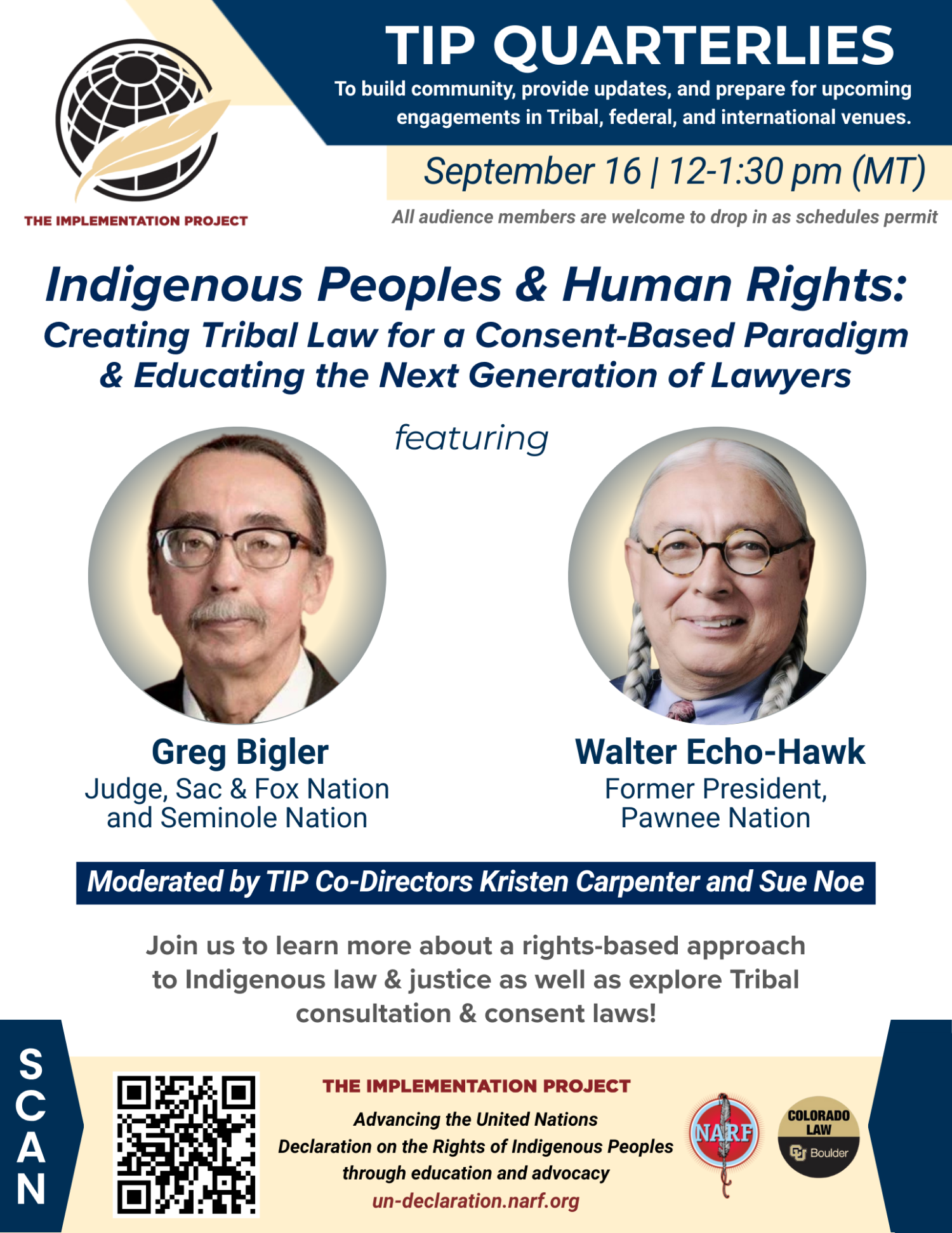
Indigenous Peoples and Human Rights Webinar - September 16, 2025, 12-1:20 MDT
AILP + NALSA Welcome Event for Admitted Students - March 14, 2025, 2:45-3:45pm
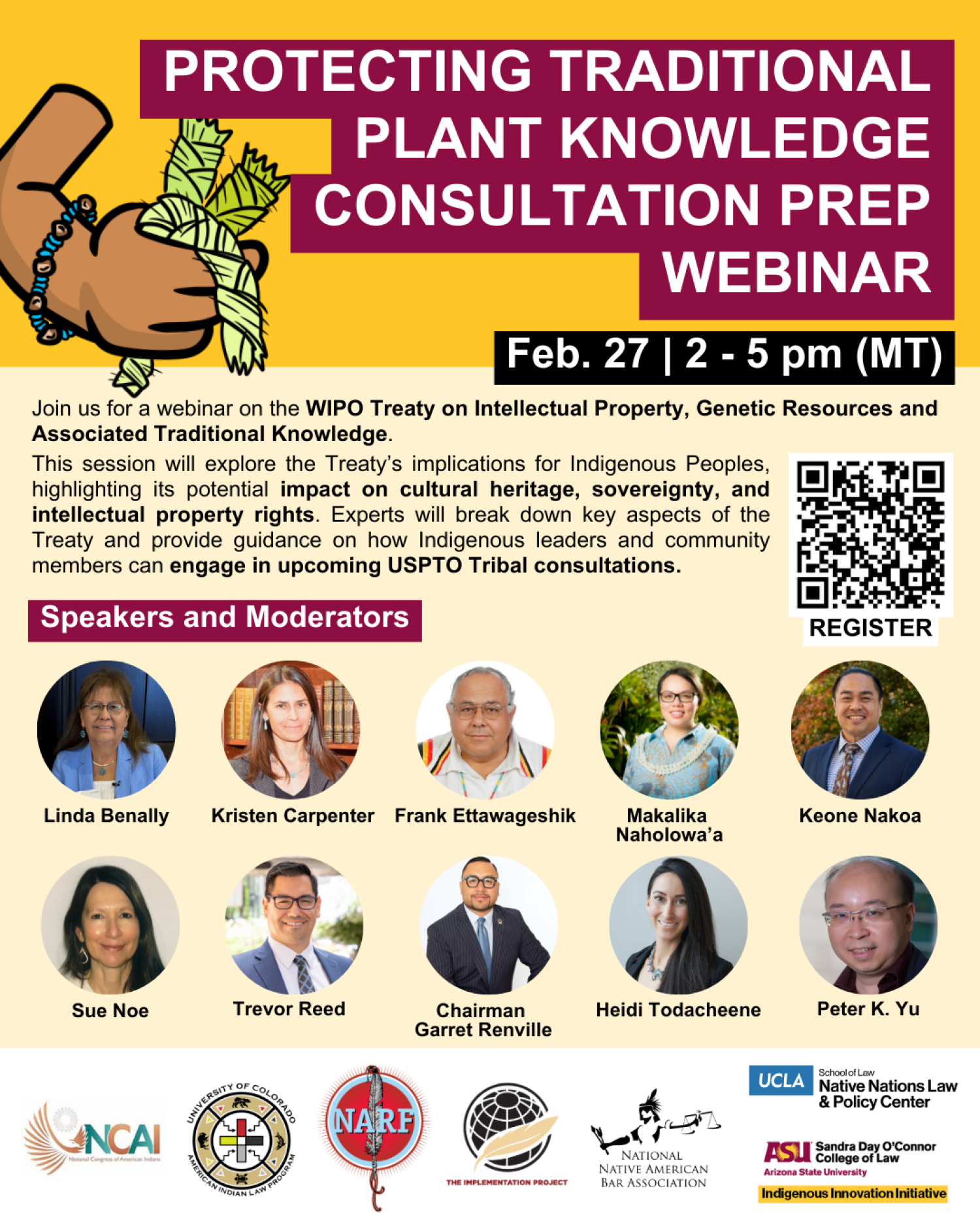
Protecting Traditional Plant Knowledge Consultation Prep Webinar - Feb. 27, 2025
Self-Determining Greenland: Understanding Inuit Rights and International Law - Feb. 24, 2025
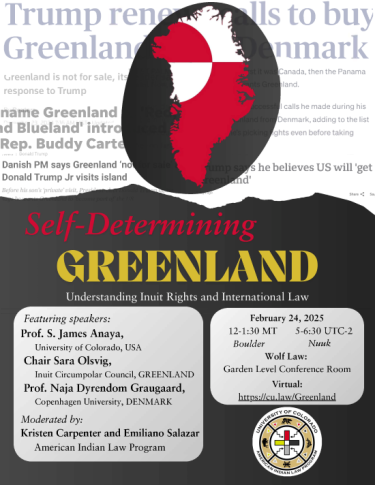
Self-Determining Greenland: Understanding Inuit Rights and International Law (Feb. 24, 2025)
For background information, review “Self-Determining Greenland: A Primer"
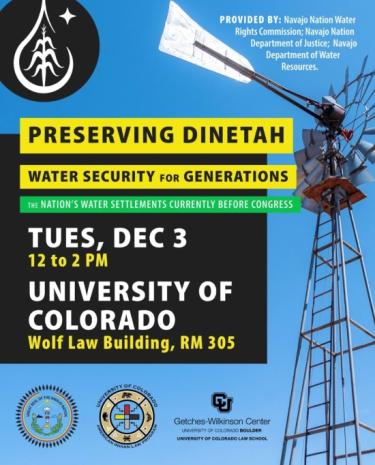
Preserving Dinetah: Water Security for Generations, the Nation’s Water Settlements Currently before Congress - Dec 3, 2024
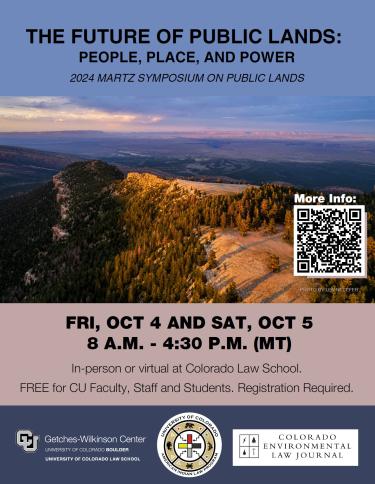
2024 Martz Symposium on Public Lands: The Future of Public Lands – People, Place and Power - Oct 4 & 5, 2024
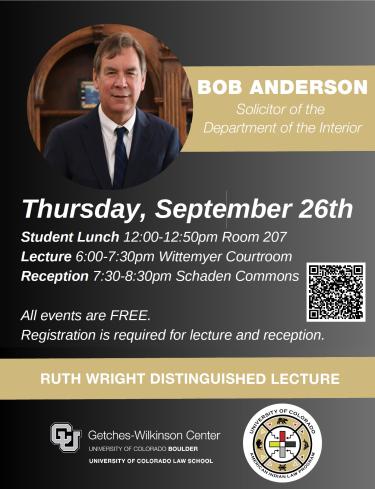
2024 Ruth Wright Distinguished Lecture in Natural Resources: Public Lands, Water, and Tribal Sovereignty in an Era of Energy Transition - Sept 26, 2024
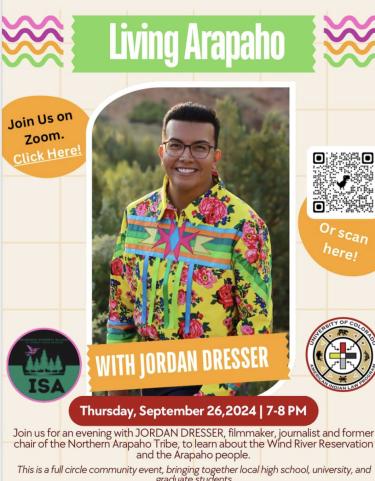
Living Arapaho with Jordan Dresser - Sept 26, 2024
The 54th Algonquian Conference - October 20-23, 2022

Indigenous Youth and Human Rights: An Indigenous Peoples Day Event - Wed., Oct. 12
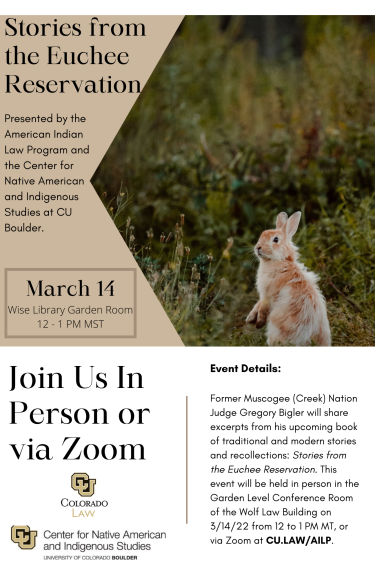
Stories From The Euchee Reservation - March, 14, 2022
Former Muscogee (Creek) Nation Judge Gregory Bigler read excerpts from his upcoming book, Stories From The Euchee Reservation, a reflection on traditional and modern stories from the Euchee Reservation. Presented by the American Indian Law Program and the Center for Native American and Indigenous Studies at the University of Colorado Boulder.
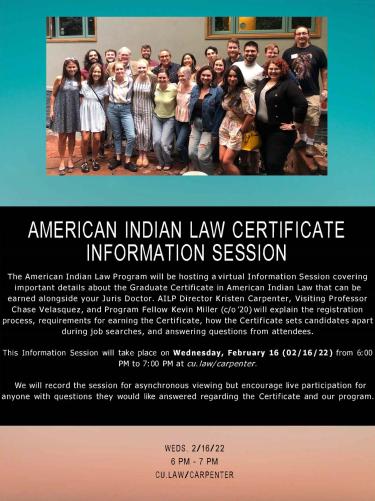
Information Session: American Indian Law Certificate - Feb. 16, 2022
The American Indian Law Program will be hosting a virtual Information Session covering important details about the Graduate Certificate in American Indian Law that can be earned alongside your Juris Doctor. AILP Director Kristen Carpenter, Professor S. James Anaya, Visiting Professor Chase Velasquez, and Program Fellow Kevin Miller (c/o '20) will explain the registration process, requirements for earning the Certificate, how the Certificate sets candidates apart during job searches, and answering questions from attendees.
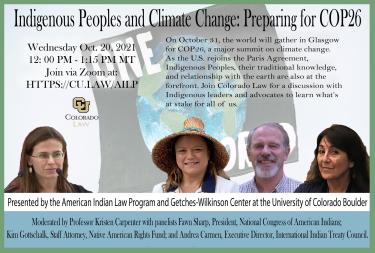
INDIGENOUS PEOPLES AND CLIMATE CHANGE: Preparing for COP26
A Zoom event featuring Fawn Sharp (National Congress of American Indians President), Kim Gottschalk (Native American Rights Fund Staff Attorney), and Andrea Carmen (International Indian Treaty Council President) to discuss the annual United Nations Climate Change Summit COP26 in Glasgow on Oct. 31 - Nov. 12, 2021.
To view the recording of this panel, please click here.
LAWYERING THE INDIAN CHILD WELFARE ACT: History and Background of the Act and Event Information
Authored by Colorado Law 2L Student Emiliano Salazar (c/o 2023)
An event presented by the American Indian Law Program with guest speakers Matthew Fletcher and Wenona Singel for a talk on the Indian Child Welfare Act, the petitions challenging the Act currently pending before the Supreme Court of the United States, and the potential ramifications for American Indians and American Indian law if the Act is ruled unconstitutional.
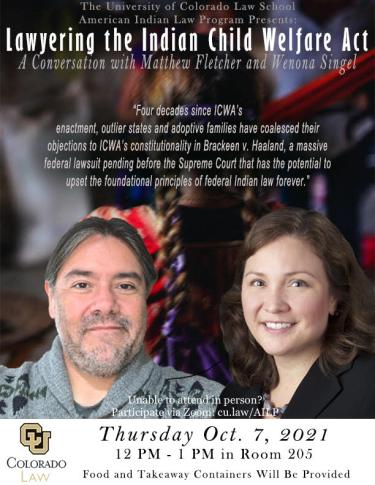
Fletcher is the Foundation Professor of Law at Michigan State University College of Law and Director of the Indigenous Law and Policy Center. He is also a member of the Grand Traverse Band of Ottawa and Chippewa Indians. Singel is an Associate Professor of Law at Michigan State University College of Law and the Associate Director of the Indigenous Law & Policy Center. She is a member of the Little Traverse Bay Bands of Odawa Indians.
The case Fletcher and Singel will be discussing is Brackeen v. Haaland (formerly Brackeen v. Bernhardt) a lawsuit brought by Texas, Indiana, Louisiana, and individual plaintiffs alleging that the Indian Child Welfare Act (ICWA) is unconstitutional. ICWA is a federal law that provides tribal governments with jurisdiction over custody, foster care, and adoption disputes that involve children residing or domiciled within reservation boundaries and children eligible for enrollment as tribal members. From the perspective of many child welfare advocates, ICWA sets the “gold standard” for maintaining children’s connections to family, culture, and community. But others perceive ICWA as a barrier to their interests in making Indian children available for adoption by non-Indians and to state sovereignty over family law matters.
ICWA (25 USC § 1915) was passed in 1978 to reverse and remedy a long history of federal policy breaking up Native families in the name of assimilating Indians into mainstream society, religion, education, and economies. For decades Indian children were removed, even absent abuse or neglect, because child welfare workers, courts, and agencies believed they would be better off with white parents. However, Congressional testimony showed the opposite; both Indian children and their families were suffering psychological and other trauma as a result of the assimilation and adoption policies.
ICWA created a series of safeguards to prevent the unlawful removal of children from their tribal lands and cultural heritage. For example, when an involuntary custody proceeding is initiated involving an Indian child as defined by statute, notice must now be issued and sent to the child’s parents, the child’s Indian custodian, and agents of each tribe in which the child may be eligible for enrollment. If a child falls under the jurisdictional rules of ICWA, the tribe can maintain jurisdiction over the custody determination and exercise authority to prioritize placement with tribally enrolled relatives or foster care providers in the absence of good cause to the contrary.
Professors Fletcher and Singel, who have authored a book on ICWA and its place in the socio-legal landscape of the United States, will be examining the case and its two overarching questions: 1) whether ICWA is unconstitutionally race-based, and 2) whether Congress exceeded its authority by entering the arena of child placement when it authorized ICWA rather than leaving Indian child placement to determination by the states.
The Brackeen plaintiffs claim that ICWA unconstitutionally discriminates against non-Indian parents seeking to adopt Indian children by focusing on race-matching, preventing the children from finding the best possible home. They say this race-based discrimination should be barred by the equal protection clause of the constitution. However, tribes and Indian advocates assert the long-standing rule that Indian status is political versus race-based and does not violate equal protection. This key distinction is at the heart of many Indian policies, such as those relating to education, housing, and healthcare.
As challenges to the ICWA unfold in the United States, the United Nations Declaration on the Rights of Indigenous Peoples provides: "Indigenous peoples have the collective right to live in freedom, peace, and security as distinct peoples and shall not be subjected to any act of genocide or any other act of violence, including forcibly removing children of the group to another group." In 2021, a study of the United Nations Expert Mechanism on the Rights of Indigenous Peoples recognized the ICWA as an important measure for advancing Indigenous children’s rights in the U.S.
For additional reading:
Leah Litman and Matthew L.M. Fletcher, The Necessity of the Indian Child Welfare Act (2020)
Colorado Law Native American Law Students Association Host 2022 National Moot Court
The National Native American Law Students Association, in partnership with the University of Colorado Law School, and the CU NALSA Chapter, are excited to host the 30th Annual NNALSA Moot Court Competition in Boulder, Colorado on February 26th and 27th, 2022.
Professor and American Indian Law Program Director Kristen Carpenter will serve as the problem author, and the competition will see teams from law schools around the country visit Colorado Law to argue before a panel of guest judges.
For more information and to stay up to date on news and information regarding this event, please visit the competition's website or contact the 2022 NNALSA Moot Court Administrator directly at nationalnalsa.mootcourt@gmail.com.
NARF-Colorado Law Implementation Project Receives Henry Luce Foundation Grant
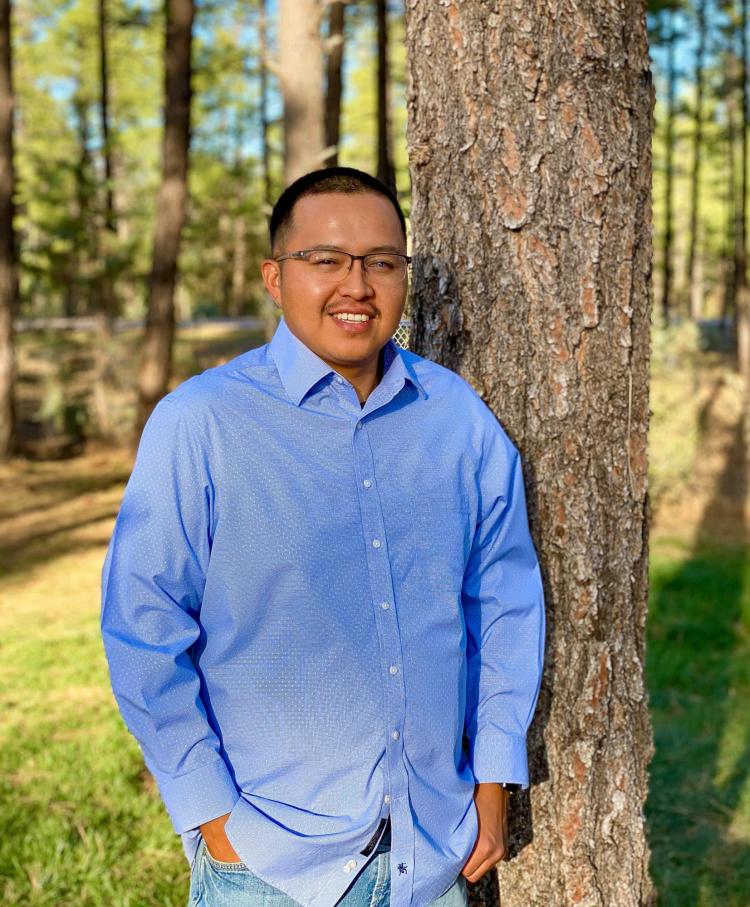
Chase Velasquez, a tribal attorney with experience at the Navajo Nation Department of Justice and the San Carlos Apache Tribe’s Department of Justice, has joined the University of Colorado Law School as a visiting clinical professor and interim director of the American Indian Law Clinic.
Velasquez is an enrolled member of the White Mountain Apache Tribe. He was raised on the Fort Apache Indian Reservation in northeastern Arizona.
Indigenous Leaders, Lawyers, and Community Members
Mark your calendars and join us for a very special webinar series featuring indigenous experts
as well as representatives from the United States Patent and Trademark Office and the
World Intellectual Property Organization.
September 10 and September 24, 2020 at 9-11 A.M. Mountain Time Zone
For more information about AILP's 2019 Conference: Implementing the UN Declaration on the Rights of Indigenous Peoples in the United States, please go to the "2019 Conference" tab.
Latest Whitepaper:
"Implementing the U.N. Declaration on the Rights of Indigenous Peoples in the United States"
March 15-16, 2019
The University of Colorado Law School and Native American Rights Fund hosted this conference as the initial program of the "Project to Implement the U.N. Declaration on the Rights of Indigenous Peoples in the United States." The conference gathered practitioners, scholars, and advocates to discuss how to advance the promises of the Declaration and develop a strategy for its implementation in the United States, toward the true flourishing of indigenous peoples, healing, and justice for all.
The conference included high-level discussions on challenges in Federal Indian Law and the role of international human rights in advocacy efforts, plus workshops on issues of tribal self-governance, land rights and sacred sites, climate change, business and entrepreneurship, Indian child welfare, technology and telecommunications, and a special feature on the UN's 2019 Year of Indigenous Languages.
University of Colorado Law School
Boulder, Colorado
"Celebrating the Tenth Anniversary of the Adoption of the United Nations Declaration on the Rights of Indigenous Peoples"
Thursday, November 5, 2015
8:30 a.m. to 5 p.m.
Wittemyer Courtroom
Monday November 10, 2014, 6:00 pm -7:00 pm
Wittemyer Courtroom
Invitation
Wolf Law Building, University of Colorado at Boulder
September 12, 2014, 8:00 am – 3:30pm
Wittemyer Courtroom
Agenda
Conference Materials
"People of the Shining Mountains: Legal Past, Present, and Future of the Ute Tribes"
April 4-5, 2013
Agenda
James S. Anaya, U.N. Special Rappateur on the Rights of Indigenous Peoples
January 25, 2013
Video Archive
Indian Country Today, January 28, 2013
Turtle Talk, January 28, 2013
American Indian Law Impact Report
American Indian Law Program Newsletters
- AILP Impact Report 2024-2025
- 2024-2025 AILP Newsletter
- Fall 2023 AILP Newsletter
- Fall 2022 AILP Newsletter
- Fall 2021 AILP Newsletter
- Winter 2000 AILP Newsletter
- December 2018 AILP Newsletter
- November 2018 AILP Newsletter
- Spring 2016 AILP Newsletter
- Spring 2015 AILP Newsletter
- Fall 2014 Newsletter
- Spring 2013 AILP Newsletter
- Fall 2012 AILP Newsletter
- Spring 2012 AILP Newsletter
Tatanka Legal Times Newsletters