

2025-26
 A pre-seed investment from Venture Partners at CU Boulder has helped spinout Illumen Therapeutics pursue a cancer-treatment “moonshot” aimed at p53, a tumor suppressor gene known as the “guardian of the genome” because it prevents damaged cells from multiplying.
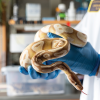 CU Boulder researchers have discovered an appetite-suppressing compound in python blood that helps the snakes go months without eating yet remain metabolically healthy. The research could inform new weight loss therapies.
 For decades, CU Boulder faculty and students have spun out “unicorn” startups—privately held companies valued at $1 billion or more. These reflect a world-class innovation ecosystem fueled by high-impact research, cross-campus collaborations and ingenious ideas.
 Most people have never heard of neodymium, a strong, silvery rare-earth element, yet almost all of us carry around a little bit of it in our pocket every day. “Your cell phone, your computer—they all rely on lanthanides, a series of 14 heavy
 Imagine a phone screen that can also harvest solar energy, extending the device’s battery life without extra hardware. This is the potential promise behind collaborative research led by Professor Michael McGehee (Chemical and Biological Engineering).
 A partnership between University Libraries and CIRES transformed thousands of analog charts into structured, searchable metadata that will help scientists discover data needed to validate tsunami models, improve forecasting accuracy, and strengthen coastal resilience and preparedness.
 The snow drought that heavily affected almost all western states this winter is linked to the interplay between the atmosphere and the ocean, said Andrew Winters, assistant professor in the Department of Atmospheric and Oceanic Sciences.
 CU Boulder researchers recently found their way atop Mount Blue Sky, one of Colorado’s famous 14ers, with the same ambitious goal: to advance quantum physics. The effort centers on determining whether time moves measurably faster farther from Earth’s center.
 Backed by renewed Department of Energy funding, the Quantum Systems Accelerator (QSA) will continue advancing cutting-edge quantum technologies as a National Quantum Information Science Research Center.
 Researchers at CU Boulder’s Laboratory for Atmospheric and Space Physics (LASP) are helping design NASA’s Habitable Worlds Observatory (HWO)—the first space telescope built specifically to detect and characterize Earth‑like, potentially inhabited planets.