

Faculty
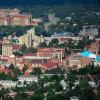 AB Nexus will hold a research blitz event – 20 participants with four-minute presentations – from 9-11 a.m. on Feb. 18 on Zoom.
 Mark Hernandez, a professor in Environmental Engineering and the Department of Civil, Environmental, and Architectural Engineering, will give a virtual presentation on the modern methods for determining the identity, distribution, and abundance of the airborne microbes that we encounter indoors and the persistence of airborne viruses such as COVID-19.
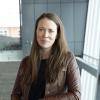 Former Mechanical Engineering faculty member Jenifer Blacklock has returned to the College of Engineering and Applied Science as the director of the Rady Program at Western Colorado University. She will lead the Western-CU Boulder Partnership Program.
 Labbe's research focuses on chemical kinetics, renewable fuels, combustion modeling, reactive flows. Her project is titled “Kinetic Behavior of Post-Flameout Ignition Events.”
 New findings from CU Boulder researchers in Physical Review Applied show that nanoscale structures on the surfaces of silicon membranes can significantly change the way that heat travels through the bulk of the membrane.
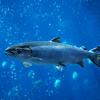 A new paper co-authored by CU Boulder researchers on Atlantic salmon could have far-reaching implications for conservation and farming of the iconic species, as well as our overall understanding of genetics.
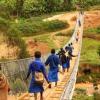 A team from the center recently published results from a pilot impact evaluation of trail bridges in rural Rwanda in PLOS ONE. They installed sensors to monitor use at 12 bridge sites constructed by Denver-based nonprofit Bridges to Prosperity.
 A simple, scratch-and-sniff test could play a key role in curbing the spread of COVID-19, at a fraction of the cost of high-tech tests that are difficult to scale and take longer to return results, new CU Boulder research suggests.
 Apresio Kefin Fajrial, a PhD candidate in the Paul M. Rady Department of Mechanical Engineering, is the first author on a new paper in Analytical Chemistry that could have implications for how we detect diseased cells.
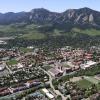 The Campus Master Plan project team is asking all interested students, faculty and staff to share their experiences and impressions of the campus through participation in an interactive mapping exercise. Your responses will help inform the project team’s efforts and help shape our campus into the future.