

New flight simulator lab for engineering education
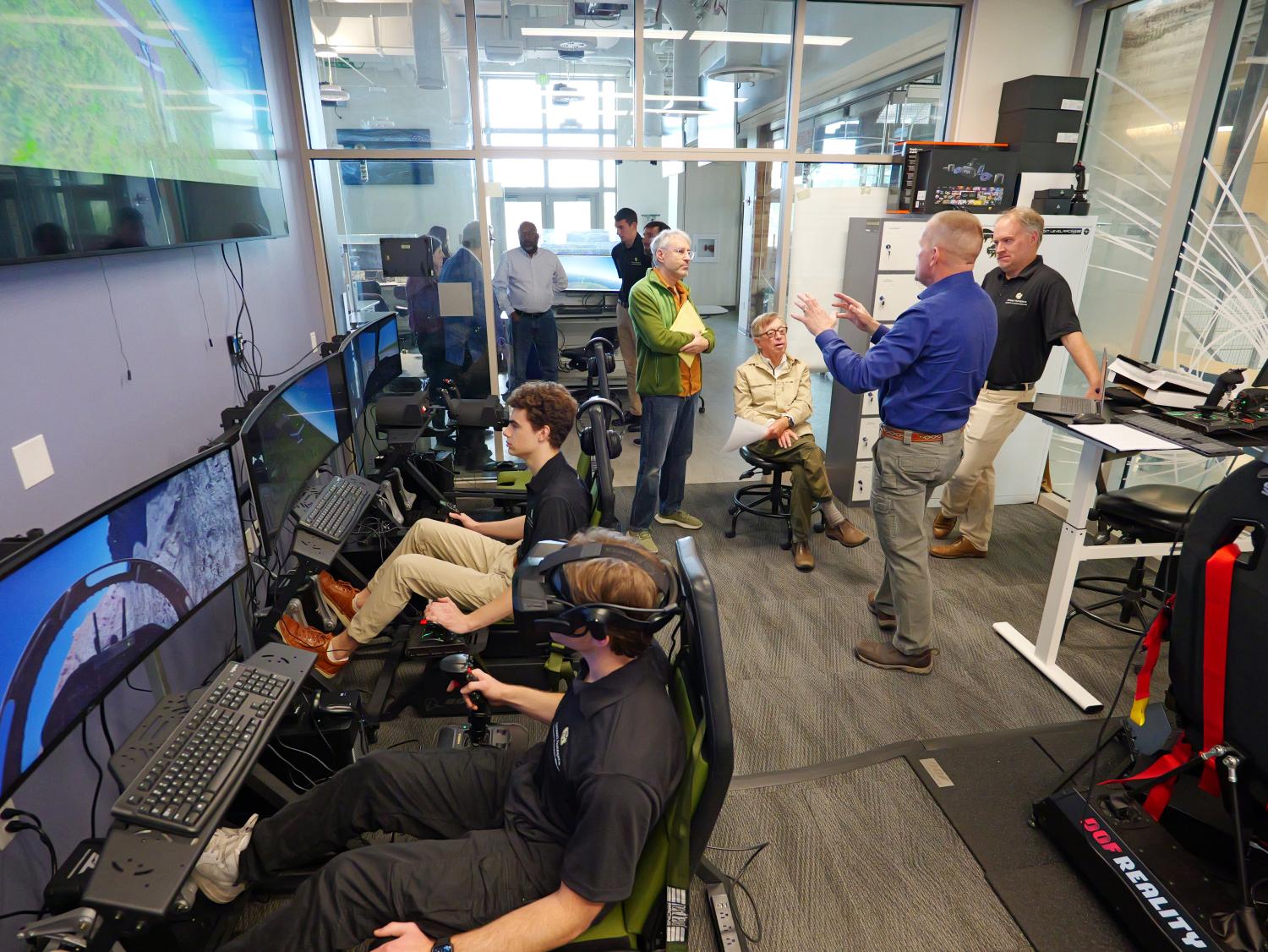
The flight simulators in use, including one with virtual reality goggles. In the background, a discussion with Schaden (seated).
Flying the (virtual) skies
Jackson Clark pushes to full throttle, pulls back on the yoke, and eases into the right rudder pedal as he soars through the sky on a clear day – all without leaving the Aerospace Building.
In a room packed with the latest in flight simulator technology, students are testing out virtual aircraft, not to become licensed pilots, but to study the engineering of aircraft design.
The Undergraduate Flight Simulation Studio is a new facility at the University of Colorado Boulder, giving students in the Ann and H.J. Smead Department of Aerospace Engineering Sciences hands-on aeronautical experience.
“You can teach with a book or on a MatLab plot, but students don’t really understand until they fly it,” said Charles Hoke, an associate teaching professor who led development of the center.
Funded with major support from aerospace engineer, attorney, and passionate CU Boulder advocate Richard F. Schaden, the facility has seven simulator bays stocked with flight yokes, rudder pedals, and aircraft throttles, complete with the myriad switches, buttons, and lights that comprise actual plane cockpits.
Students also have the option of wearing virtual reality headsets for a 360-degree experience.
“As a pilot, I have flown in flight simulators over the past 35 years to demonstrate compliance with the performance, stability and control of aircraft as they were designed,” said Schaden, who visited the lab for an official unveiling May 7. “Now, here in the lab, students can experiment with design changes to see the effects on the performance, stability and control as modified by them as engineers. This allows the students to experience immediate engineering feedback in ways that may be more precise than they could achieve through wind tunnel tests ”
The lab allows students the chance to test classroom projects and new aircraft concepts. It also offers the ability to show how small changes in existing planes alter their airworthiness.
You can teach with a book or on a MatLab plot, but students don’t really understand until they fly it." - Charles Hoke
“Standard flight simulators are for pilot training,” Hoke said. “That’s not useful for engineers. We want to get into the guts of these things, change the parameters, and learn about aircraft dynamics.”
The lab will be a standard component of sophomore-level courses, impacting over 300 students per year. It will also be available for clubs and other projects.
Students have already been able to use the facility to test plane designs they developed as part of spring semester capstone senior projects. By loading 3D models of their aircraft into the simulator, they were able to collect high fidelity data on drag and aerodynamic performance for analysis
“It has been really cool to see senior project teams come in and use the tools,” said Clark, an aerospace master’s student who helped build the facility. “It’s incredibly immersive and shows the vision for this lab is immediately being applied.”
Hoke also emphasized the simulator’s value as a learning tool.
“When teams design an airframe, they get the chance to fly at Boulder Model Airfield, but you’re lucky to get 1-2 flights. With this simulator, they could fly their designs for hours and hours and get more data for analysis. When I came to CU Boulder, I made it my mission to create a facility like this. It’s very exciting to see it come to life.”