

Chemical Engineering
 Meet the Department of Chemical and Biological Engineering's newest faculty, Assistant Professors Cody Ritt and Antonio Del Rio Flores.
 Chemical and biological engineering researchers have created shape-shifting microparticles that change their shape in response to environmental factors for self-directed propulsion and navigation.
 A CU Boulder team has invented a sound-wave technique that softens dense tumors so chemotherapy can penetrate more deeply. The discovery could boost treatment effectiveness and make cancer therapies safer for patients.
 The recognitions reflect Coleman's work as a teaching assistant for six classes; his strong academic performance—including three graduate-level classes—and his research, where he served as first author on two papers stemming from his undergraduate thesis. It also reflects his time spent as a ChBE student ambassador.
 Chemical and Biological Engineering PhD Student Bruce Kirkpatrick was honored with the 2025 Outstanding Dissertation Award. His hydrogel research supports technologies that enable 3D cell culture for tissue engineering and disease modeling, as well as acellular biomaterials for applications like controlled release of drugs or vaccines.
 A new CU Boulder study published in the Proceedings of the National Academy of Sciences reveals how electric fields control nanoparticle movement through porous materials, enabling independent control of speed and direction. This finding could advance nanorobot technologies for applications like tumor detection, drug delivery and environmental cleanup of toxic chemicals.
 The win came at the American Institute of Chemical Engineers’ international Chem-E-Car competition in Boston, where CU Boulder’s poster stood out among 56 teams.
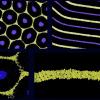 Assistant Professor Ankur Gupta, the study’s lead researcher, and his team have developed a way to simulate natural animal patterns, including their imperfections. The findings could lead to new materials that turn to camouflage on demand.
 The project, like something straight out of a health sci-fi movie, combines RNA-based gene therapy with tiny microrobots for drug transport to help treat acute respiratory distress syndrome (ARDS).
 Adding to a growing list of honors, Assistant Professor Ankur Gupta has been awarded the Royal Society of Chemistry’s 2025 Soft Matter Lectureship — a prestigious recognition of outstanding early-career researchers in the field.