

Fall Teaching, Learning, and Technology Conference 2026 - Innovating the Large Lecture
The Center for Teaching & Learning (CTL) and Office of Information Technology (OIT) invite all CU educators and community members to join us for our annual Fall Teaching, Learning, and Technology Conference 2026.
Are you ready to innovate your large lecture with pedagogical strategies and technology tools that work? If yes, join colleagues from across campus to share ideas, connect with campus offices that offer resources to support your teaching and well-being, and gain practical strategies you can immediately apply in your large lecture classroom. Don't miss this interactive one-day conference designed to inspire new ideas and help you make an even greater impact on student learning.
Register for Fall Conference 2026
When:
- Thursday, October 15th – 8:30 AM to 3:00 PM MT
Where:
Hybrid Format - Choose what works best for you:
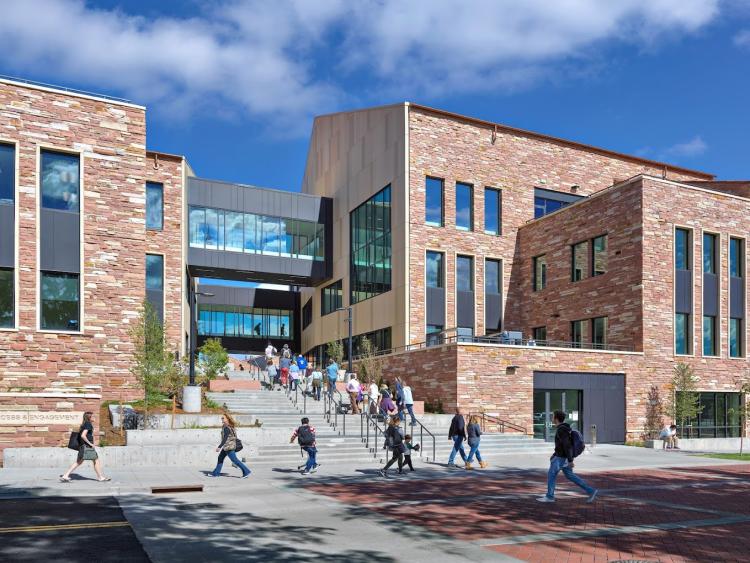
- In Person:Center for Academic Success and Engagement (CASE), Rooms E-390 and E-351
- Remote: Via Zoom (University of Colorado Systemwide authentication to join)
- Zoom Link for Room E-390: https://cuboulder.zoom.us/j/98857031994
- Zoom Link for Room E-351: https://cuboulder.zoom.us/j/96322730101
(*Please log in to your CU Boulder Zoom account with your IdentiKey and password before joining the session(s) on Zoom)
Keynote Speakers
- Dr. Kirk Ambrose, Interim Vice Provost for Academic Assessment and Planning
- Dr. Liu Liu, Assistant Professor, Marketing (Leeds School of Business), recipient of the 2026 CTL Excellence in Teaching with Technology Award
Units Tabling at Networking Lunch Session:
- WorkWell
- Office of Information Technology (OIT)
- Digital Accessibility Office (DAO)
- Student Outreach, Advocacy & Support (SOAS)
- Basic Needs Center (BNC)
- Writing Center
- Office of Victim Assistance (OVA)
- Office of Institutional Equity and Compliance (OIEC)
Fall Conference 2026 - Schedule
Please log in to your CU Boulder Zoom account with your IdentiKey and password before joining a session on Zoom.
| Time | Room E390 | Room E351 |
| 8:30 - 9:00 AM MT | Title: Welcome/Land Use Keynote Speakers:
| |
| 9:00 - 9:50 AM MT | Title: Small Group Activities for Engagement in Large Courses How can we get students to practice the kind of thinking we want them to learn in a large lecture course? This session describes a practical approach to incorporating small-group activities into lecture classes to give students frequent opportunities to apply concepts, interpret data, solve complex problems, and explain their reasoning. The presentation will discuss how to design and implement activities, provide support and accountability in large classes, and efficiently grade student work. Slides: Presenter:
Title: Two-Stage Exams in a Large Lecture Course Two-Stage Exams (also known as Group Exams) bring peer instruction and group work into the exam environment. In this session, we will describe the motivations and goals for implementing two-stage exams and discuss the practicalities of doing this in a course with more than 1,000 students, drawing on our experience in the physics department at CU Boulder. Slides: Presenter:
| Title: Big Class, Bigger Impact! A Trifecta of Engagement Technologies to Enhance Student Metacognition In this session OIT's Alex Jones and Rob Leary will explore WeVideo, iClicker, and Class Capture, showing how you can utilize each to enhance learning before, during, and after your large lecture class. Slides: Presenter:
|
| 10:00 - 10:50 AM MT | Title: Making a Large Class Feel Like a Small Class: Strategies for Community Building Large classes can often feel intimidating or impersonal, with students feeling as if they do not know their peers or their professors. This diminished sense of community has been linked empirically to reduced student motivation, engagement, and attendance (e.g., Blatchford & Russell, 2020; Cash et al., 2017). In this session, "Making a Large Class Feel Like a Small Class: Strategies for Community Building," I will share strategies I have used in my large classes to build relationships with students (as well as help students build relationships with their peers) and make a large lecture hall feel like a friendly and welcoming place. Slides: Presenter:
Title: From No-Tech to Cutting Edge: Encouraging Active Learning in Large Courses with Pen and Paper This session will discuss two strategies for building community, sharing student knowledge, and increasing engagement in large classes by using frequent, low-stakes formative assignments. These assignments are done in person, written by hand and turned in on paper, and thus require no classroom technology (Clickers, etc.), limited advance preparation, and are resistant to the use of generative AI. Slides: Presenter:
| Title: Peer Instruction in Your Classroom: Writing Great Questions and Facilitating Discussion Questioning is a central part of student assessment and quizzing, but it can also be a powerful learning tool. How does a teacher use questioning effectively? What is the right number of questions to ask? How do we avoid just giving students the answer? How do we avoid embarrassing our students, or confusing the class, if they give me the wrong answer? In this interactive presentation, we’ll start to explore research-based tips and ideas for questioning in a way that allow us to achieve the full benefit of questioning student engagement and deep learning. We will focus on the use of “peer instruction” – the practice of requiring students to discuss their answers to challenging questions with one another. Slides: Presenter:
|
| 11:00 - 11:50 AM MT | Title: Student Panel Slides: Presenters:
| Title: Universal Design for Learning and Digital Accessibility Meeting the needs of all students can be difficult in any course, and this challenge is magnified in large lecture courses where students might feel dissuaded from bringing up their specific needs with their instructors. Proactively building courses with accessibility in mind helps mitigate this issue while also creating a more intuitive and useful digital content for all students. This session will cover digital accessibility and Universal Design for Learning (UDL) and participants will understand the impact of how these concepts reduce barriers, increase flexibility, and improve the learning experience for all students. Slides: Presenters:
|
| 12:00 - 1:30 PM MT | 12:00 - 1:30 PM - Lunch 12:00 - 1:30 PM - Tabling 12:30 - 1:00 PM - WorkWell Wellness Wagon | |
| 1:30 - 2:00 PM MT | Break | |
| 2:00 - 3:00 PM MT | Large Course Community of Practice (LCCoP) Meeting |