


Prioritizing research and innovation: A look back and ahead with Massimo Ruzzene
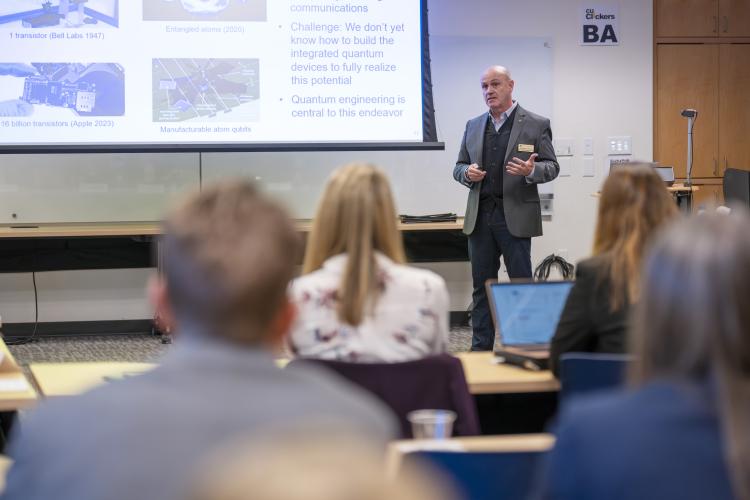
As the fall semester winds down, CU Boulder continues to build momentum toward our strategic research and innovation goals. We continue to lead nationally and globally in established strengths in aerospace and space, health and biosciences, sustainability and the environment, and quantum science and technology, while areas as varied as the social sciences and the arts and humanities also continue to thrive.
More than ever, CU Boulder is a destination for faculty, students and staff who want to change the world through innovative research, scholarship and creative work.
Senior Vice Chancellor for Research and Innovation and Dean of the Institutes Massimo Ruzzene sat down with us to reflect on what stood out this semester, why it matters and what’s ahead in 2026.
How has CU Boulder advanced in research and innovation this semester?
The semester has been an extraordinary time for research and innovation because of the rapidly changing federal environment, as well as the commitment and success of our people in the face of those changes.
Faculty, students and staff responded to the incredible pace of federal change and the longest government shutdown in history with perseverance, resourcefulness and determination to maintain our momentum and enable continued breakthroughs in research, innovation and impact.
Our researchers have continued to thrive, as demonstrated by ongoing, significant successes: Clarivate’s Highly Cited Researchers 2025 list includes 19 CU Boulder-affiliated faculty spanning the campus; NASA announced that instruments designed and built by Laboratory for Atmospheric and Space Physics (LASP) researchers have been selected for the upcoming Artemis IV mission; the Department of Energy (DOE) renewed funding to the tune of $125 million for the Quantum Systems Accelerator (QSA), a DOE National Quantum Information Science Research Center; and we celebrated two major awards—totaling $45 million—from the Advanced Research Projects Agency for Health (ARPA-H), one for self-healing joints and one for advanced wound care. These are just a few examples.
CU Boulder was recognized for launching 35 new companies based on university intellectual property during FY2024, more than any other U.S. campus in that timeframe. CU Boulder now ranks No. 2 for the most startups launched in any single year by a U.S. campus. The startups represent an array of industries, from clean energy to biotech. Examples include: Mana Battery, developing a safer, more sustainable alternative to lithium-ion technology; Flari Tech, advancing technology to detect diseases via the breath; and Mesa Quantum, utilizing next-gen chip-scale atomic clocks and quantum sensors to power autonomous vehicles, advanced deep-water oil exploration and more.
What projects are you most excited about for the year ahead and why?
A few of the projects worth keeping an eye on include:
The recently launched Industry Research Partnerships (IRP) team is creating lots of excitement. Through innovative contracting, access to top student and faculty talent, developing new funding streams for CU Boulder research, and the capacity to scale, IRP is simplifying the path to innovation and helping industry and CU Boulder collaborate to solve complex problems and shape the future together. The new team is already making waves across campus, and early indications are impressive.
Our quantum efforts continue to accelerate and reap results. Our CUbit Quantum Initiative unites and drives quantum activities across campus, bolstering research, education and commercialization, including supporting the new Colorado Quantum Incubator (COQI). The COQI is regularly welcoming new tenants, attracting community events and becoming a hub for the regional quantum ecosystem.
Our other strategic research initiatives—the Sustainability Research Initiative, Center for National Security Initiatives and AB Nexus—continue to expand and engage across campus and beyond to discover innovative approaches, new funding mechanisms and novel partnerships to drive research and innovation breakthroughs in today’s challenging environment.
How can faculty, staff and students help achieve these goals?
Faculty and staff can participate through genuine engagement with research and innovation enterprise offerings: whether exploring our bi-weekly RIO Bulletin newsletter for funding and development opportunities, participating in programs and workshops, or finding ways to learn more about the resources that can support the important work taking place across campus.
Students already engaged in research can benefit from many of the same approaches. Students not already engaged in research or innovation activities across campus: I invite you to explore research and innovation opportunities in your areas of interest—from business or law to music or art—to learn how they can enhance your learning and career opportunities.
More from campus leadership
- Prioritizing people: A look back and ahead with Janel Forde
- Prioritizing resource and infrastructure alignment: A look back and ahead with Todd Haggerty
- Prioritizing faculty success: A look back and ahead with Ann Stevens
- Prioritizing research and innovation: A look back and ahead with Massimo Ruzzene
- Prioritizing sustainability: A look back and ahead with Andrew Mayock
- Making progress on campus priorities—a Q&A with the chancellor