


A powerhouse in battery breakthroughs
Photo: Nick Singstock , CTO and co-founder of new CU Boulder startup Mana Battery holds up a prototype of their new sodium-based battery.
The University of Colorado Boulder is at the cutting edge of battery technology, from groundbreaking research to billion-dollar ventures.
When Tyler Evans (Alum: CU Boulder Paul M. Rady Mechanical Engineering and Material Science) was applying to PhD programs, he knew he wanted to focus on batteries. “I remember having this impression that batteries were literally a way to bottle up energy and put it in your pocket and use it to do what you wanted, anytime you wanted, and that feels a lot like a superpower,” he said.
That was the start of an exciting era in energy storage, and the race was on to build a better battery that lasted longer, was safer and less expensive. At the time, there were just a handful of universities, including CU Boulder, working on that kind of technology, and Evans was interested in working specifically with Se-Hee Lee (CU Boulder Paul M. Rady Mechanical Engineering), a pioneer in solid state battery technology who had joined CU Boulder from the National Renewable Energy Laboratory (now the National Laboratory of the Rockies) several years earlier.
Photo: Tyler Evans, CEO and co-founder of Mana Battery, alum of CU Boulder CU Boulder Paul M. Rady Mechanical Engineering and Material Science.
Evans felt an immediate affinity with Lee’s research objectives and lab culture and wanted to join his team. “Because I knew I wanted to study energy storage and new battery technologies, the support I found was instrumental in setting me up not just to be a good battery scientist and technologist but also to look at the world through the lens of application and understand what could be useful for the world.”

Photo: Tyler Evans , CEO and co-founder of Mana Battery, alum of CU Boulder CU Boulder Paul M. Rady Mechanical Engineering and Material Science.

Photo: Se-Hee Lee (left) and Conrad Stoldt (right) both faculty and researchers in CU Boulder's Paul M. Rady Mechanical Engineering, in their lab at CU Boulder, using a glovebox. The glovebox is used to handle battery materials in an oxygen- and moisture-free environment, preventing reactions with air and enabling the safe development of next-generation energy technologies.
Soon, Evans was part of the team generating test data that led to grant funding for Solid Power Inc., a company spun out of the university by Se-Hee Lee and Conrad Stoldt (CU Boulder Paul M. Rady Mechanical Engineering). At the same time, Evans was crossing paths with Doug Campbell —Solid Power’s co-founder and a deep tech startup veteran, then its CEO—and Josh Buettner Garrett , the company’s CTO. Through those interactions, Evans was learning about the commercialization path for university lab innovations. “It felt exciting to be a part of that, to see your work have a pretty immediate and direct impact on a company that was hopefully going to make a real impact in the world,” he said.
Photo: Se-Hee Lee (left) and Conrad Stoldt (right) both faculty and researchers in CU Boulder's Paul M. Rady Mechanical Engineering, in their lab at CU Boulder, using a glovebox. The glovebox is used to handle battery materials in an oxygen- and moisture-free environment, preventing reactions with air and enabling the safe development of next-generation energy technologies.
Since then, Solid Power has become an industry-leading developer of next-generation all-solid-state battery technology. The company went public in 2021 with major partnership deals with BMW, Ford and Samsung SDI and now has a 75,000-square-foot manufacturing facility in Thornton. As a company co-founder, Lee is excited to see Solid Power at the forefront of this technology, and he’s equally gratified that the company has hired many past CU Boulder undergraduate, Master’s and PhD students. “Creating so much opportunity for the younger generation, that’s kind of the most exciting stuff,” said Lee.
“Incredible productivity in battery innovation”
Lee was also the principal investigator (PI) guiding the team that led to the spinout of another company, this one co-founded by Evans and fellow student Daniela Molina Piper (Alum: CU Boulder Paul M. Rady Mechanical Engineering). That venture was SiILion Inc., which focused on developing high-energy, non-flammable, Li-ion (lithium-ion) systems for solid state batteries. Evans saw a new Li-ion cell technology through prototype and early-pilot demonstrations until 2018, when the company was acquired by Tesla.
Photo: Early prototypes of the Solid Power solid state batteries.
Solid Power and SiILion put CU Boulder on the map for battery breakthroughs, giving the outside world a sense of the high caliber of research coming out of the university, according to Bryn Rees, senior associate vice chancellor for innovation and partnerships. Soon thereafter, in 2020, Michael Marshak (Fmr. CU Boulder Chemistry) founded Otoro Energy Inc. to commercialize a breakthrough flow battery—a rechargeable battery in which electrolyte flows through one or more electrochemical cells from one or more tanks—technology developed in his lab. The company’s patented low-cost electrolyte, licensed from CU Boulder, uses abundant and non-critical minerals, is water-based (pH-neutral), non-corrosive, non-flammable and non-toxic. “We’ve had this incredible productivity in battery innovation at CU. It’s a unique strength that we’ve got here,” said Rees.

Photo: Early prototypes of the Solid Power solid state batteries.
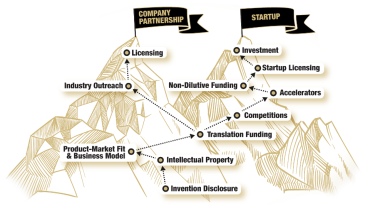
But what is "commercialization?"
The path to commercialization—also known as "research translation" or "tech transfer"—can be challenging, so Venture Partners unites industry partners, entrepreneurs and investors to help researchers, inventors and creators at the University of Colorado bring their groundbreaking discoveries into the marketplace.
Other prolific university labs have contributed to advancing battery technologies in unexpected and intriguing ways. Take Alan Weimer ’s (CU Boulder Chemical and Biological Engineering) lab, where students work at the forefront of innovation in atomic layer deposition (ALD) nanocoating technology. That’s the process of putting down ultra-thin coatings on particles and plastics to improve the performance of new and existing products, including batteries. Researchers on Weimer’s team have shown that, with lithium-ion batteries, ALD can improve performance, extend life cycle and enhance safety in consumer electronics like laptops, cell phones and electric vehicles.
Photo: Factory floor of Forge Nano.
Weimer co-invented the core ALD tech that formed the foundation for an early spinout, ALD NanoSolutions Inc., which merged with Forge Nano Inc. in 2021. Forge Nano was co-founded by Paul Lichty (Alum: CU Boulder Paul M. Rady Mechanical Engineering and Chemical and Biological Engineering) and Dave King (postdoctoral research assistant) both formerly part of Weimer’s team. Lichty, now Forge Nano’s CEO, developed and patented an idea for scaling up the ALD process, and the company now uses the technology to make scalable nano-coatings for various applications, including batteries, semiconductors, and more. Forge Nano’s proprietary ALD formulation, called “Atomic Armor,” makes batteries’ electrodes better at storing energy. “It's difficult to think of anything else I could have done that would have as big an impact as this company,” Lichty has said.

Photo: Factory floor of Forge Nano.

A photo of the Ban Group, including Tyler Evans (left, furthest back), Chunmei Ban (center right), and Nick Singstock (far right)
Photo: Ban Group, including Tyler Evans (left, furthest back), Chunmei Ban (center right), and Nick Singstock (far right)
An ecosystem of great battery scientists
CU Boulder researchers like Lee, Lichty and Evans have distinguished themselves by taking on the tough challenges inherent in advancing batteries and storage tech, and successfully pushing those innovations out into the world in an unprecedented and meaningful way. “The notion in the field was that battery technology is too hard, and it’s too hard for these companies to successfully raise capital. It’s too hard for them to get partnerships and to commercialize. Yet what we’ve seen at CU Boulder has totally turned that thinking upside down,” said Rees. “These really great research capabilities have translated into super impactful ventures.”
Several factors make CU Boulder a powerhouse for battery innovation, according to Evans. “The Front Range and CU Boulder have a unique confluence of ingredients that have [contributed] to our strong track record of battery technology companies in the last decade or so,” he said. “First, the network of universities, national laboratories and entrepreneurial resources provides a pool of world-class people and creates fertile ground for breakthroughs. Second, the representation of major players in the energy industry and industries that use battery technology… creates pull for new technologies with a focus on building commercial value. And finally, situated at the foot of the Rocky Mountains, the people here have a very direct connection to the environment; we’re intimately linked to the impact of our work.”
Evans is now CEO and co-founder of Mana Battery Inc., a 2023 spinout of Chunmei Ban ’s (CU Boulder Paul M. Rady Mechanical Engineering) lab. Ban, company co-founder and a leading researcher in batteries and battery materials, focuses on next-generation electrochemical materials, specifically sodium and magnesium, to meet the need to improve renewable energy storage systems. Mana Battery is advancing that groundbreaking work by developing sodium-ion batteries that are cheaper, safer and longer-lasting than standard lithium-ion ones.
At a CU Boulder-hosted conference on batteries and storage technology in 2024, Ban commented, “The U.S. has one of the largest sources of soda ash. The reserve is huge, so we have the resources to do something, and I feel it’s the right time,” she said. “We feel confident about our technology, a gigantic market for batteries is already here, and I have a great team.”
At that same meeting, Evans expressed gratitude at being part of the ecosystem of great battery scientists at the university. “CU Boulder has a really impressive track record in the battery space, and Mana is sitting in a place to enable a sodium-ion battery transition; they do everything lithium-ion can do at half the cost, which the grid needs. Batteries have the potential to change the world.”
What can we do together?
The Newsroom
For marketing and communication inquiries or news tips, contact Daniel Leonard, senior marketing and communications specialist for Venture Partners at CU Boulder.
For media inquiries, please visit colorado.edu/news/formedia.