


6 things CU Boulder research has taught us about cannabis
It’s Cannabis Awareness Month, and few universities have done as much as CU Boulder to advance our scientific understanding of Cannabis sativa.
In 2017, researchers at the Center for Health & Neuroscience, Genes & Environment (CUChange) unveiled the nation’s first mobile laboratory, a.k.a. Cannavan, for studying the plant’s real-time impact on users.
Since cannabis remains illegal at the federal level, university researchers are not permitted to possess or provide commercially available cannabis products for research. The van—now a fleet of three Dodge/Mercedes sprinter vans—gets around that scientific obstacle, enabling research teams to drive to the off-campus home of study subjects who have already consumed their own cannabis products and invite them in for everything from blood and cognitive tests to roadside sobriety tests.
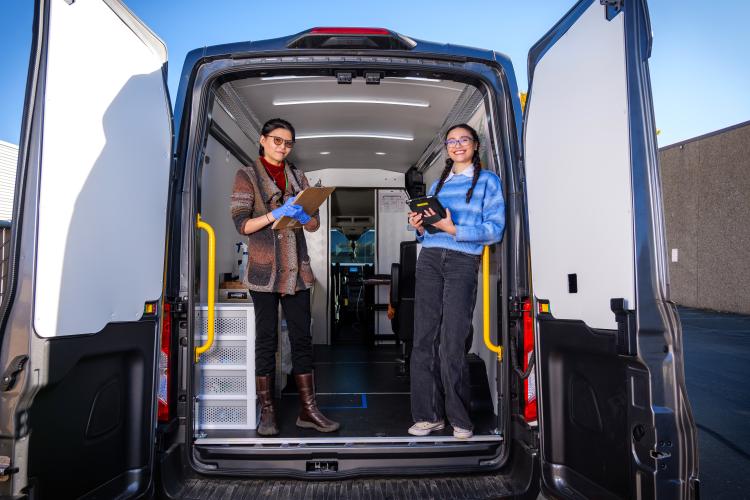
Professional research assistants Paige Xiaoying Phillips (left) and Gray MacDonald pose for a photo inside the mobile pharmacology lab, a.k.a. the Cannavan, at CU Boulder.
This, and other research efforts across campus have contributed dozens of scientific studies to the field at a time when all but 10 states allow use of cannabis for medical purposes and half permit recreational use.
“As one of the first groups in the country to study real-world cannabis use with rigorous, ecologically valid methods, we’ve had the opportunity to lead work that helps bridge science and lived experience-so individuals, clinicians, and policymakers can make more informed, evidence-based decisions,” said associate professor Cinnamon Bidwell, who co-leads CUChange with Psychology Professor Angela Bryan.
Here’s a snapshot at what CU research has revealed so far, and what scientists are working to learn.
Don’t always trust the labels
Nearly half of cannabis flower products are inaccurately labeled when it comes to potency, with most showing they contain more THC than they really do, according to a study published in the journal Scientific Reports. Meanwhile, labels on cannabis concentrates like oils and waxes tend to be accurate, with 96% shown to match what’s inside. Read more.
Weed can make workouts more fun but it does not enhance performance
A study of 42 runners, published in the journal Sports Medicine, shows THC and CBD products can increase positive mood and enjoyment during exercise, but THC can also increase heart rate and make exercise feel more effortful. Read more.
CBD can ease anxiety without the risks that can come with THC
The study of 300 people, published in the journal Cannabis and Cannabinoid Research, was the first randomized trial to examine how legal, commercially available cannabis impacts anxiety symptoms.
The study comes as one in five U.S. adults suffer from an anxiety disorder and prescriptions for anti-anxiety medications are on the rise. Read more.
Cannabis may ease ‘chemo brain’ and improve sleep among cancer patients
The study, published in the journal Exploration in Medicine, is among the first to assess how cannabis bought over the counter at dispensaries—rather than government-supplied or synthetic varieties—impacts cancer symptoms or chemotherapy side effects. It also sheds light on the wide variety of products cancer patients use now that marijuana is legal in most states. Read more.
Can taking CBD help people use less weed? A new study explores
An ongoing CU Boulder study is exploring whether taking cannabidiol (CBD), a non-intoxicating ingredient in the Cannabis sativa plant, can help people with an unhealthy dependency smoke less weed or give it up entirely. Read more and watch a video.
A THC breathalyzer? It’s in the works
Fourteen years after Colorado and Washington became the first U.S. states to legalize recreational cannabis, police still lack a reliable method for detecting whether someone smoked a joint or ate a gummy recently and whether they are too impaired to drive.
Researchers at CU Boulder hope to help solve that problem, using a laboratory on wheels and state-of-the-art chemistry to map the peaks and declines of a cannabis high in real time. Read more.