


Chancellor advocates for building funding before state Capital Development Committee

CU Boulder leadership, including Chancellor Justin Schwartz, far left, and Senior Vice Chancellor for Finance and Business Todd Haggerty, far right, join CU system and UCCS leadership for a group photo after presenting to the Capital Development Committee at the capitol in Denver. Photo by Glenn Asakawa/University of Colorado.
On Dec. 17, CU Boulder Chancellor Justin Schwartz and other representatives from the CU campuses presented capital requests for the 2026–27 fiscal year to the Colorado General Assembly’s Capital Development Committee. The annual hearing continues a longstanding tradition of advocating for investments in the university’s historic buildings and infrastructure that have shaped both the campus and the state for generations.
During the presentation, Schwartz emphasized that CU Boulder’s capital priorities are intended to benefit not only the university community but Colorado as a whole. “These projects will not only have a significant impact on CU Boulder faculty, staff and students but also in many ways on the broader Colorado economy,” he said, underscoring the university’s role as an economic and cultural driver for the state.
The annual presentation allows University of Colorado campuses and state agencies to outline requests for maintenance and construction funding, enabling the committee to make recommendations to the Joint Budget Committee. The state budget bill released in the spring ultimately determines which projects receive funding.
Capital requests: Preserving history, advancing opportunity
Macky Auditorium renovation
Macky Auditorium, a cornerstone of the Norlin Quadrangle Historic District, has weathered 103 years of use. The university proposes a three-phase renovation, providing 60% of the funding ($50.6 million in cash) and requesting just over $33.8 million from the state. Of the $84.4 million total project cost, $28.4 million addresses deferred maintenance.
Macky’s classrooms serve departments such as Cinema Studies, Theatre and Dance, and Germanic and Slavic Languages, supporting hundreds of students and faculty. The renovation will upgrade building systems, stabilize the structure, address drainage and moisture issues, restore historic elements and improve energy efficiency. Notably, state support for Macky Auditorium is linked to Boulder’s selection as the new home of the Sundance Film Festival, amplifying its cultural significance.
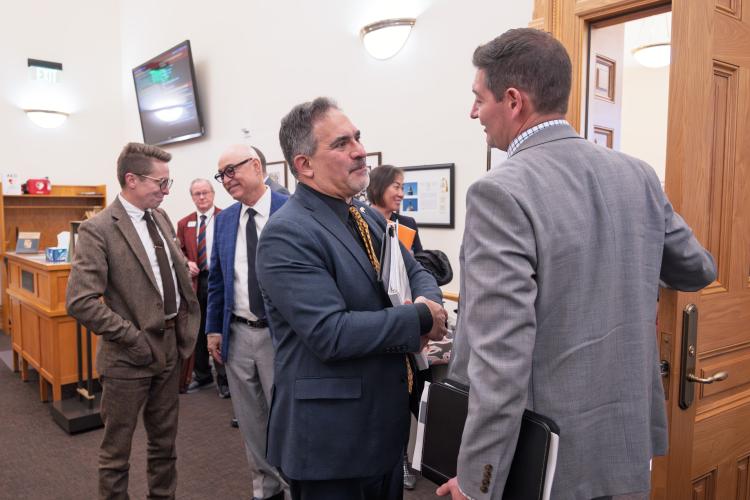
CU Boulder Chancellor Justin Schwartz, center, talks with Chad Marturano, CU system vice president and chief financial officer, after presenting to the Capital Development Committee at the capitol in Denver. Photo by Glenn Asakawa/University of Colorado.
Guggenheim Geography building renovation
The Guggenheim Geography building, untouched by significant remodels since 1908, is slated for a comprehensive $53 million renovation over two phases, with the university providing 60% of funding and requesting $21.2 million from the state. The project will address health, life-safety and code improvements, including asbestos mitigation, fire safety upgrades, HVAC and electrical systems, and restoration of historic elements.
Guggenheim supports 114 faculty, staff and graduate students, delivering thousands of credit-hours, serving a broad swath of the student body. The renovation will create more energy-efficient, usable space, supporting up to 20 academic programs and helping students graduate on time.
Commitment to deferred maintenance and sustainability
CU Boulder faces a $1.64 billion deferred maintenance backlog. The university’s strategy integrates emerging needs into repairs, increases space utilization rates, improves efficiency and life-cycle costs, leverages sustainability improvements, and mitigates potential problems before they arise.
Meanwhile, the university remains committed to incorporating sustainable features into its operations and buildings. Recent sustainability milestones include the launch of the Buckley Center for Sustainability Education, elimination of single-use beverage plastics and groundbreaking on 5MW of solar power.
Accountability through results
Schwartz closed the presentation by thanking the committee and legislative partners for their support of the recently completed renovation of the Hellems Arts and Sciences building, which reopened this month after more than two years of work supported by university resources and state funding. He noted that the project preserved the building’s historic character while improving accessibility, energy efficiency and modern learning spaces, and highlighted its role in bringing students back to classrooms this spring.