


Research and recognition: Ethan Coleman

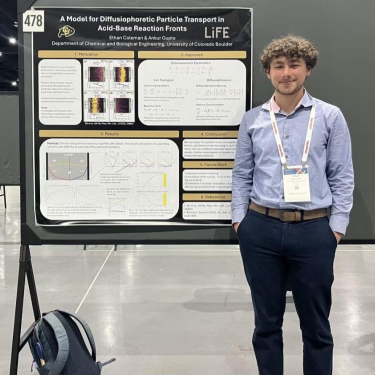
Applied Mathematics major Ethan Coleman’s undergraduate research in Assistant Professor Ankur Gupta’s Laboratory of Interfaces, Flow and Electrokinetics (LIFE) addressed a nuanced question: How do microscopic particles move in complex chemical environments? His work led to two first-author papers and earned him three of the College of Engineering and Applied Science’s fall undergraduate awards, including the Outstanding Undergraduate of the College, recognizing not just academic performance, but teaching, research, and leadership.
Explaining a puzzling experiment
In Coleman’s first paper, “Diffusiophoresis in acid-base reaction fronts with and without an isoelectric point: When, why, and where the particles focus”, Coleman tackled an experimental mystery. Microparticles had been observed to focus at acid–base reaction fronts, defying classical predictions. Coleman showed that the key was a pH-dependent surface charge. By incorporating realistic variations in particle zeta potential, he explained when and where particles concentrate, reconciling theory with experiment and opening new avenues for controlling particle transport.
Untangling complex particle motion
Coleman’s second paper, “A pinch of salt in a pinch of salt: Diffusiophoresis in concentration gradients of three ionic species”, addressed a fundamental challenge in diffusiophoresis – the motion of particles driven by chemical gradients. While systems with two ions are well understood, adding a third creates nonlinear interactions that are difficult to predict.
Coleman developed a linearized model for three-ion systems, revealing when simple approximations work and when they fail. His framework provides both the mathematical corrections and the physical intuition needed to understand particle motion in multi-ion environments – insights that could benefit both microfluidic design and biophysical research.
Awards for a holistic undergraduate experience
Coleman’s research accomplishments were complemented by a remarkable academic record. He completed a double major in Chemical and Biological Engineering and Applied Mathematics in just nine semesters, served as a teaching assistant for four classes, and contributed as a student ambassador and participant in the Global Engineering Residential Academic Program.
The College recognized his holistic contributions with the Research Award, the Academic Engagement Award, and the Outstanding Undergraduate of the College, underscoring not just grades or publications, but the breadth of his impact on peers, classrooms, and research labs.
Mapping out the future
Coleman plans to continue working in the LIFE lab for several months post-graduation and is applying to PhD programs in chemical and biological engineering. Further information regarding Ethan Coleman’s awards can be found in the article published by the Chemical and Biological Engineering Department regarding his accomplishments.