

Why a boy and his tiger still matter
Top image: Rachel Schmidt/Encyclopedia Britannica
Calvin and Hobbes, Bill Watterson’s beloved comic strip, ended three decades ago this month, yet its magic endures, says William Kuskin, CU Boulder English professor and expert on comics and graphic novels
When teaching his popular course on comic books and graphic novels, William Kuskin’s classroom represents a microcosm of the university, where engineering majors sit alongside business students and aspiring writers.
In that mix, the comic strip Calvin and Hobbes, which debuted in November 1985, sparks an enthusiasm across students—even though the comic strip ended its syndicated run in December 1995, before most of those students were born, says Kuskin, a University of Colorado Boulder Department of English professor and department chair.
“Students will march down at the end of class and gush about Calvin and Hobbes,” he says. “It’s not just nostalgia; there’s an ongoing love for it in this generation.”

William Kuskin, CU Boulder department chair and professor of English, teaches a course on comics and graphic novels that draws students from disciplines across the university.
That love often comes with a personal twist.
“A lot of dads and kids sat around reading comics together,” Kuskin explains. “Students tell me this course brings them closer to their dads. There’s a comic culture out there that spans generations.”
While no new Calvin and Hobbes comic strips have been produced since 1995, author Bill Watterson authorized the publication of 18 books between 1987 and 2005 that reprinted comic strips from various years. In honor of the publication of the three-volume The Complete Calvin and Hobbes in 2005, re-runs of comic strip were made available to newspapers from Sept. 4, 2005, to Dec. 31, 2005.
Kuskin says the beloved comic strip is not just a relic of the bygone newspaper era—it’s a shared language of humor and imagination between generations.
Describing Calvin and Hobbes to a newcomer
How does one describe what Calvin and Hobbes is about to the uninitiated?
Kuskin says the task is not as easy as it sounds, because the comic transcends its characters. On one level, it’s about Calvin, a mischievous 6-year-old boy who enjoys undertaking adventures with his stuffed tiger, Hobbes, who seemingly comes to life with biting humor when alone with Calvin. Beyond that, Kuskin says, it’s about the endless possibility of childhood, served up with doses of humor, philosophy and whimsy.
He identifies two endearing qualities that he says gives the comic strip its remarkable staying power. The first is its balance of cynicism and sentimentality.
“Calvin and Hobbes critiques the world but ends with love and warmth,” he says. “As cruel as the outside world is, they still have time for a hug. Our world needs that—maybe now more than ever.”
Kuskin says Watterson’s work reminds its audience that skepticism doesn’t have to cancel tenderness. He notes that Calvin’s sharp observations about consumerism or dreary school regimen coexist with moments of pure joy—snowball fights, sled rides and bedtime musings.
Calvin and Hobbes invites readers to slow down, to imagine, to laugh—and perhaps to question what really matters, Kuskin says.
“Our culture promotes avarice and excess over happiness and personal expression,” he says, quoting Watterson: ‘To invent your own life’s meaning is not easy, but it’s still allowed, and I think you’ll be happier for the trouble.’”
Kuskin says the second appeal of Calvin and Hobbes results from the comic strip’s role as a portal to the imagination.
“Hobbes himself is a gateway,” he says of Calvin’s stuffed tiger. “He’s both real and imaginary. That ambiguity invites readers to participate in the magic.”
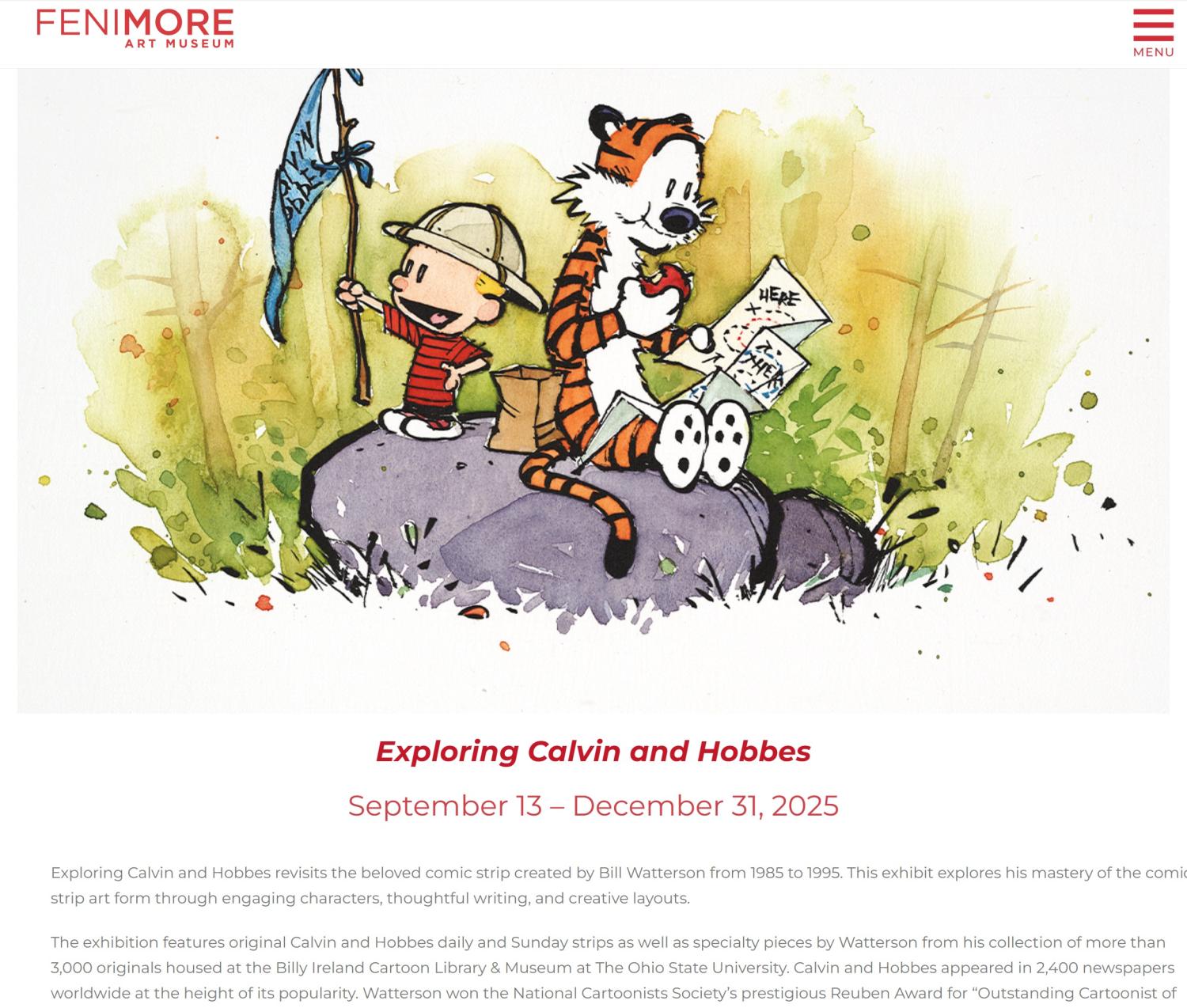
The Exploring Calvin and Hobbes exhibit will be open to the public through Dec. 31 at the Fenimore Art Museum in New York City. (Screengrab: Fenimore Art Museum)
From cardboard-box “transmogrifiers” to intergalactic daydreams, Kuskin says the comic strip celebrates childhood imagination. Hobbes—neither fully stuffed nor fully alive—embodies that space where fantasy and reality blur, Kuskin says.
Comics as high art
Kuskin says the recent Calvin and Hobbes exhibition at the Fenimore Art Museum in New York underscores the comic strip’s artistic stature, which he sees as part of a broader movement to elevate comics.
“Comics have a fundamental tension,” he explains. “They don’t belong comfortably to any one discipline. They’re literature, but they’re also visual art. And they’re tied to franchise culture.”
That tension creates a spectrum—from mass-market superhero films to avant-garde graphic novels. Watterson, like Art Spiegelman (author of Maus), staked out the high-art end of that spectrum, resisting the strong pull of merchandising, Kuskin says.
“He stood by his principles. He made his art. It’s beautiful and lasting,” he adds. “There are many ways to make comics, but Watterson’s way—purity of vision, resistance to exploitation—defines a kind of artistic practice that’s very beautiful.”
Art over commerce: Watterson’s high road
Unlike many cartoonists who embraced merchandising, Watterson famously resisted commercialization. Thus, no Hobbes plush toys and no animated specials. Kuskin sees that as a principled stand.
“Watterson fought hard for artistic control,” he says. “He framed his work as art, connecting back to early innovators like George Herriman (Krazy Kat) and Winsor McCay (Little Nemo). Comics often straddle art and commerce—Watterson pushed toward high art.”
That decision was not without cost. While Peanuts became a multimedia empire—complete with beloved TV specials—Calvin and Hobbes remained confined to the printed page. That purity may be why the strip feels timeless rather than dated, Kuskin says.
“Would the world have been better for a few more Hobbes stuffed animals snuggled in at night?” he muses. “Watterson thought not. He believed the work should speak for itself.”
The cultural company Calvin and Hobbes keeps
Will CU Boulder students still be talking about Calvin and Hobbes in another 10 years?
“Calvin and Hobbes critiques the world but ends with love and warmth,” he says. “As cruel as the outside world is, they still have time for a hug. Our world needs that—maybe now more than ever.”
Kuskin doesn’t hesitate in his response: “Absolutely. Parents and grandparents will keep sharing it. And it’s entered that rare cultural space—like Spider-Man, Batman or even Marilyn Monroe. It’s iconic.”
That “iconic space” includes other comic strips that transcended their medium: Peanuts, Krazy Kat and Little Nemo. Like them, Kuskin says, Calvin and Hobbes combines accessibility with depth—simple enough for children but layered enough to be appreciated by adults.
“The best comics have always transcended age,” he says. “They’re not just for kids. They explore fantasy, philosophy—even avant-garde art.”
And while Calvin and Hobbes often gets mentioned in the same breath as Peanuts, Kuskin says featuring cute kids and animals is not a prerequisite for a comic strip having enduring appeal.
“Will Dilbert ever go away? I can’t imagine—it nails corporate life,” he says.
Endings as beginnings
For Kuskin, Watterson’s final comic strip—with Calvin and Hobbes sledding into a snowy landscape—is a farewell, but also a reminder that imagination is infinite.
“It’s about endings as beginnings,” he explains. “The snow becomes a metaphor for possibility. Watterson’s goodbye is a clean start—not an end.”
The dialogue is simple: “It’s a magical world, Hobbes, old buddy … let’s go exploring.” But Kuskin says its resonance in the comic panels is profound: the blank whiteness of snow mirrors the blank page—a canvas for imagination.
“The snow looks like snow because we invent it as snow in our imagination,” he says. “That’s the genius of Watterson—he makes us co-creators.”
Did you enjoy this article? Subscribe to our newsletter. Passionate about English? Show your support.