

Ocean Biogeochemistry Research Group
We use climate models and oceanographic observations to study the biogeochemistry of the ocean, including its carbon cycle. Many of our studies look at the connection between the ocean carbon cycle and the atmospheric carbon dioxide (CO2) concentration.






- Marvin Alfaro, Undergraduate SMART Summer Intern, 2010
- Riley Brady, Graduate Student, Ph.D., 2021
- Gabriela Cazares, Undergraduate SOARS Summer Intern, 2019
- Katherine Chan, Undergraduate SMART Summer Intern, 2016
- Genevieve Clow, Graduate Student, Ph.D., 2026
- Christopher Conrad, Graduate Student, M.S., 2014
- Allysa Dallmann, Undergraduate SOARS Summer Intern, 2021
- Shana Egan, Undergraduate RESESS Summer Intern, 2021
- Geneviève Elsworth, Graduate Student, Ph.D., 2022
- Amanda Fay, Research Associate, 2016-2017
- David Feagins, Undergraduate SMART Summer Intern, 2019
- Natalie Freeman, Graduate Student, Ph.D., 2017
- Will Geiken, Undergraduate Summer Intern, 2014
- Luise Gleason, Undergrad RESSES Summer Intern, 2023
- Tessa Gorte, Graduate Student, Ph.D., 2024
- Joe Gradone, Undergraduate Honors Student, B.A., 2016
- Brianna Green, Undergraduate RESESS Summer Intern, 2019
- Isis Guadalupe-Díaz, Undergraduate SMART Summer Intern, 2020
- Nahir Guadalupe-Díaz, Undergraduate ATOC REU Summer Intern, 2021
- Jaime Herriot, Undergraduate ATOC REU Summer Intern, 2022
- Cheryl Harrison, Research Associate, 2017-2018
- Adelecia Johnson, Undergraduate RESESS Summer Intern, 2018
- Lindsey Kropuenske, Visiting Postdoctoral Researcher, 2011-2013
- Kristen Krumhardt, Graduate Student, Ph.D., 2018
- Joanna Lester, Visiting Graduate Student, 2017
- Andrew Margolin, Undergraduate Honors Student, B.A., 2012
- Trevor Masters, Undergraduate SMART Summer Intern, 2025
- Leslie Montoya, Undergraduate RESESS Summer Intern, 2016
- David Munro, Postdoctoral Research Associate, 2012-2016
- Gabriela Negrete-García, Undergraduate SOARS Summer Intern and Professional Research Associate, 2017-2018
- Cara Nissen, Postdoctoral Research Associate and Research Associate II, 2022-2024
- Holly Olivarez, Graduate Student, Ph.D., 2024
- Zoraida Pérez Delgado, Undergraduate SOARS Summer Intern, 2014
- Valeria Pérez Rivera, Undergradate SMART Summer Intern, 2022
- Reema Shinh, Undergraduate SMART Summer Intern, 2021
- Katherine (Katie) Shrader, Undergraduate ATOC REU Summer Intern, 2023
- Justin St. Cloud, Undergraduate Summer Intern, 2024
- Giuliana Turi, Visiting Postdoctoral Researcher, 2015-2016
Contact
Our beliefs
Goals
The ocean biogeochemistry research group conducts modeling and observational studies in all aspects of modern-day ocean biogeochemistry. Our goals are threefold:
- To understand the mechanisms that control the distributions of biogeochemical constituents in the ocean,
- To study the ocean biogeochemical response to climate change and climate variability,
To quantify feedbacks between ocean biogeochemistry and the climate system.
Research
Our research is primarily focused on the ocean carbon cycle, one of the most important biogeochemical cycles in the ocean.
In particular, we study the connection between the ocean carbon cycle and the atmospheric carbon dioxide (CO2) concentration. As the ocean contains 60 times more carbon than the atmosphere, it exerts a dominant control on atmospheric CO2. Biological and physical processes act together to control the distribution of carbon in the ocean, and therefore the flux of CO2 between the ocean and the atmosphere.
We employ a variety of ocean and earth system models, and we use satellite and in situ observations.
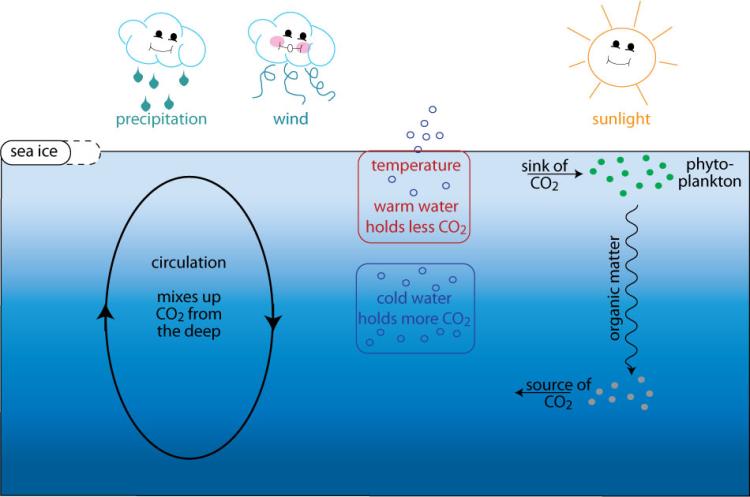
Schematic illustration of the processes impacting ocean-atmosphere carbon dioxide exchange.
Modeling
Modeling is a critical tool for the study of physical, biogeochemical, and ecological processes in the ocean. We use a variety of modeling tools in our research, ranging from simple box models to state-of-the-art coupled carbon-climate models. Such models allow us to simulate important biogeochemical quantities, and to understand what controls their distribution.
The Lagrangian transport of dissolved carbon dioxide in the Southern Ocean from a high-resolution ocean model. (credit: R. Brady)
Observations
Satellite and in situ observations of ocean biogeochemical quantities help us to validate our models and to quantify recent changes in ocean biogeochemistry. These observations provide information about the amount of anthropogenic carbon dioxide in the ocean, the changing acidity of the ocean, and the activity of ocean phytoplankton in the sea surface, among other things.
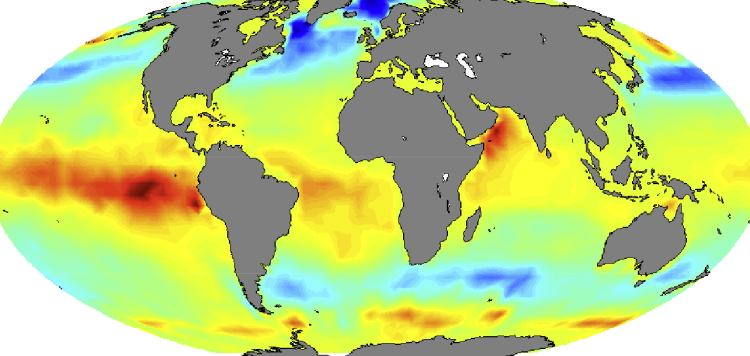
Sea-to-air flux of carbon dioxide, estimated and interpolated from ship observations.
News
Publications
Publications for Lovenduski are shown below