

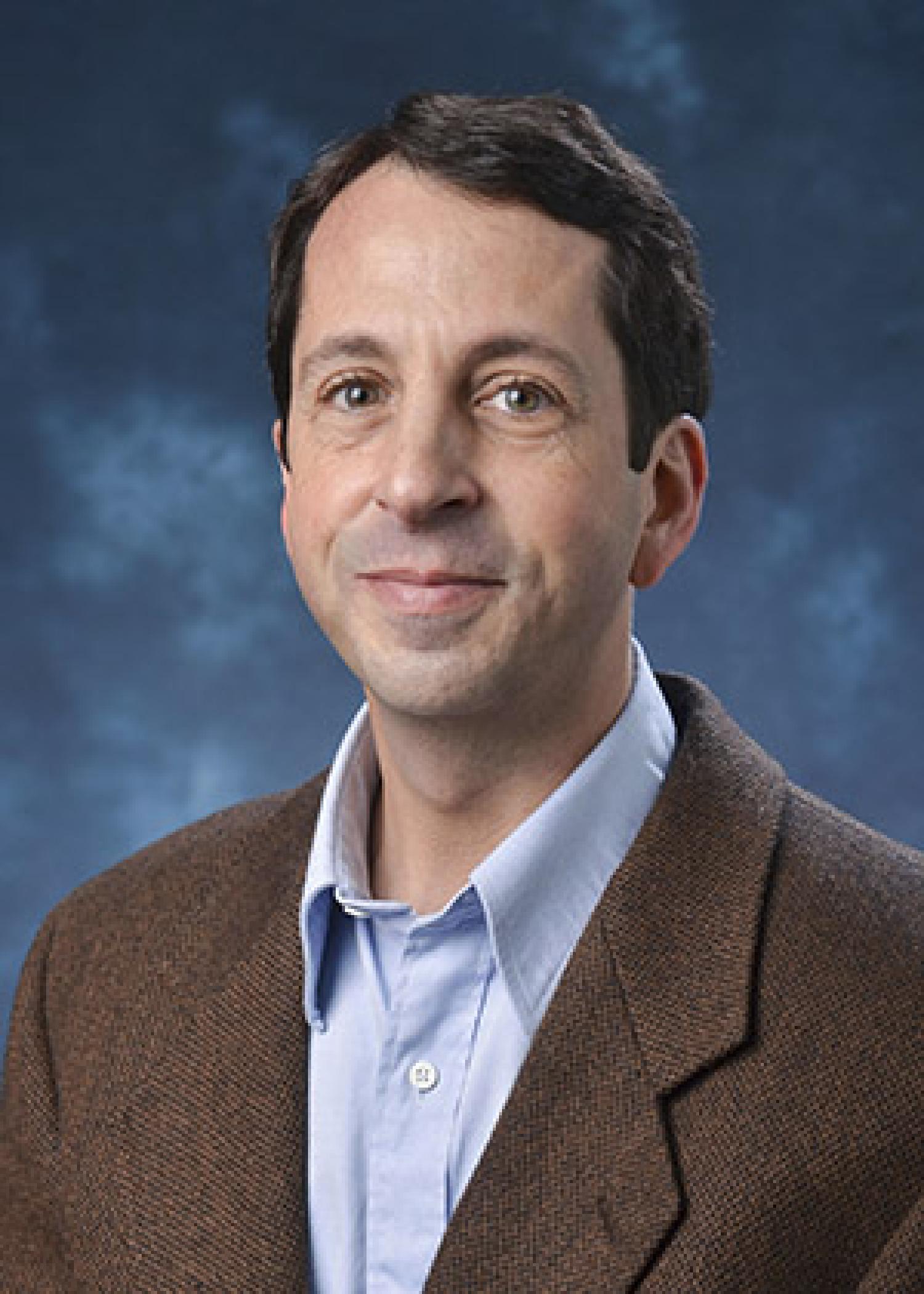
Steven Pollock
- Professor
- PHYS Faculty Mentor (Student's Last Name: H-J)
- PHYSICS
Office: DUAN F1013
Office Hours: Monday 1:00 - 2:00 p.m. and Thursday 11:00 - 12:00 p.m. • Location: I prefer in person (F1013) but Zoom is available upon request.
Biography:
I'm a Professor of Physics at CU Boulder. I came to CU Boulder in 1993, working in theoretical nuclear physics. Specifically, I studied electroweak interactions in the nuclear domain with a focus on tests of the Standard Model, and investigation into the sea-quark substructure of nucleons. I switched to the area of Physics Education Research in the early 2000's, and have continued since then on projects involving the use of Learning Assistants in physics courses, issues associated with transferring research-based curricula across different environments, questions of equity and inclusion especially in introductory physics, and more recently curriculum design and assessment tools with a focus on upper-division courses (E&M, Classical, Quantum Mechanics, and now Quantum Information).
Research Interests:
Physics Education Research, including large-scale classes, teacher prep, and upper-division classes (curriculum design and assessment)
I study student learning in physics classes, and the constraints and opportunities involved in replicating "proven" curricular practices. I am currently co-PI on two research projects, one to study and improve quantum simulations in Phet, the other to design and assess student learning in Quantum mechanics and Quantum computing contexts. More broadly, I study how educational models and practices can be extended to the upper division, including research and development of materials, curriculum, and assessment tools in Classical Mechanics, E&M, and Quantum Mechanics.
Selected Publications:
- “Intuition in Quantum Mechanics: Student perspectives in upper-division quantum mechanics.”, G. Corsiglia, S.Pollock, and G. Passante, Phys. Rev. Phys. Educ. Res. 19, 010109 (2023), https://doi.org/10.1103/PhysRevPhysEducRes.19.010109
- “Adaptable research-based materials for teaching quantum mechanics," S. Pollock, G. Passante, H. Sadaghiani, American Journal of Physics 91, 40 (2023); https://doi.org/10.1119/5.0109124
- “Today’s interdisciplinary quantum information classroom: Themes from a survey of quantum information science instructors”, J. C. Meyer, G. Passante, S. Pollock, B. Wilcox, Phys. Rev. Phys. Educ. Res. 18, 010150 (2022), https://link.aps.org/doi/10.1103/PhysRevPhysEducRes.18.010150
- “Demographic gaps or preparation gaps?: The large impact of incoming preparation on performance of students in introductory physics”, Shima Salehi, Eric Burkholder, G. Peter Lepage, SJP, and Carl Wieman. Phys. Rev. ST Phys. Educ. Res. 15, 020114 (2019) (Editor’s Suggestion) https://doi.org/10.1103/PhysRevPhysEducRes.15.020114
- “Educational transformation in upper-division physics: The Science Education Initiative model, outcomes, and lessons learned”, S. V. Chasteen, B.R. Wilcox, M. D. Caballero, K. K. Perkins, SJP, C. E. Wieman, Phys. Rev. ST Phys. Educ. Res. 11, 020110 (2015) (PER focused collection), https://doi.org/10.1103/PhysRevSTPER.11.020110