

Communication


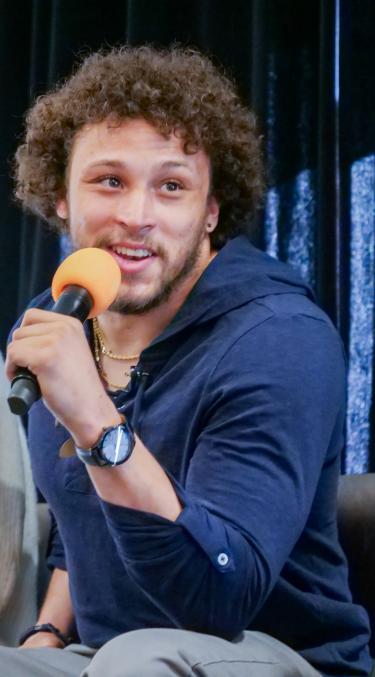
Phillip Lindsay (Comm'17)
Houston Texans (formerly Denver Broncos)
Welcome to the Department of Communication.
Explore how communication shapes everything we do in society. Learn how to analyze and influence human interaction in work, personal and civic life.
In the Department of Communication, you will learn about communication practices that underlie all of our social interactions, both in face-to-face interaction and in new forums, such as social media.
Your education will enable you to enact change in your personal life, work life and civic life.
The Department of Communication at the University of Colorado Boulder is a vibrant community of scholars who share a commitment to excellence and innovation in communication research and teaching. The department offers programs leading to bachelors, masters, and doctoral degrees with emphases in organizational communication, discourse and society, and rhetoric and culture. Graduate students may pursue research within one of these areas or craft individualized programs of study that cut across the areas and combine humanistic and social scientific methods.
Undergraduate Opportunities
Our undergraduate degree blends the best of a broad, liberal arts education with practical skills that contribute to career and life success.
You will come to understand communication as both a way of seeing how the world works and as a set of tools for changing it.
You’ll learn how to analyze and engage effectively in a wide range of communication practices. You will also gain valuable communication skills—speaking, listening, managing conflict, building consensus, analyzing audiences, designing messages and solving problems in a collaborative way.
You may also minor in communication.
Graduate Programs
Graduate study in the department focuses on engaged scholarship that addresses communication-based problems arising from recent social and technological changes, especially problems associated with processes of interaction, collaboration and participation, deliberation and decision making.
Graduate students pursue research within three main areas—Community and Social Interaction, Organizational Communication and Rhetoric and Culture—crafting individualized programs of study that meet their individual needs.
With full-time study, the master’s program can be completed in two years.
Our doctoral program is one of the premier programs in the world, providing graduate students with advanced work in the communication discipline that earns them academic positions at all levels of higher education, including research universities, liberal arts universities and teaching-centered colleges. The degree is also appropriate for some nonacademic careers, such as organizational communication consulting.
With normal progress (full-time), the degree can be earned in four years.
COMM Partners

Schedule a consultation

Fosters community and knowledge through community engagement

Communicating care for environmental, economic and social justice.

Published work from the Communication faculty
Communication Careers
- General business and corporate communication
- Nonprofit organizations
- Fundraising
- Human resource management
- Speech writing
- Mediation and negotiation
- Hospitality management
- Health communication
- Media and entertainment
- Communication consulting and training
- Sales and marketing
Communication Alumni
- Catherine Zublin ('77)
Interim dean, Lindquist College of Arts and Humanities, Weber State University - Tracy Wahl ('90)
Executive Producer for Executive Franchises, NPR - Erin Scholz ('97)
Women’s basketball coach, Fresno Pacific University - Anne Knapp ('03)
Staff Assistant to the U.S. Ambassador, Jordan
Contact the Department of Communication
Communication
CASE Building
University of Colorado Boulder
UCB 200
Boulder, CO 80309-0200
303-492-7306