

Feedback Control
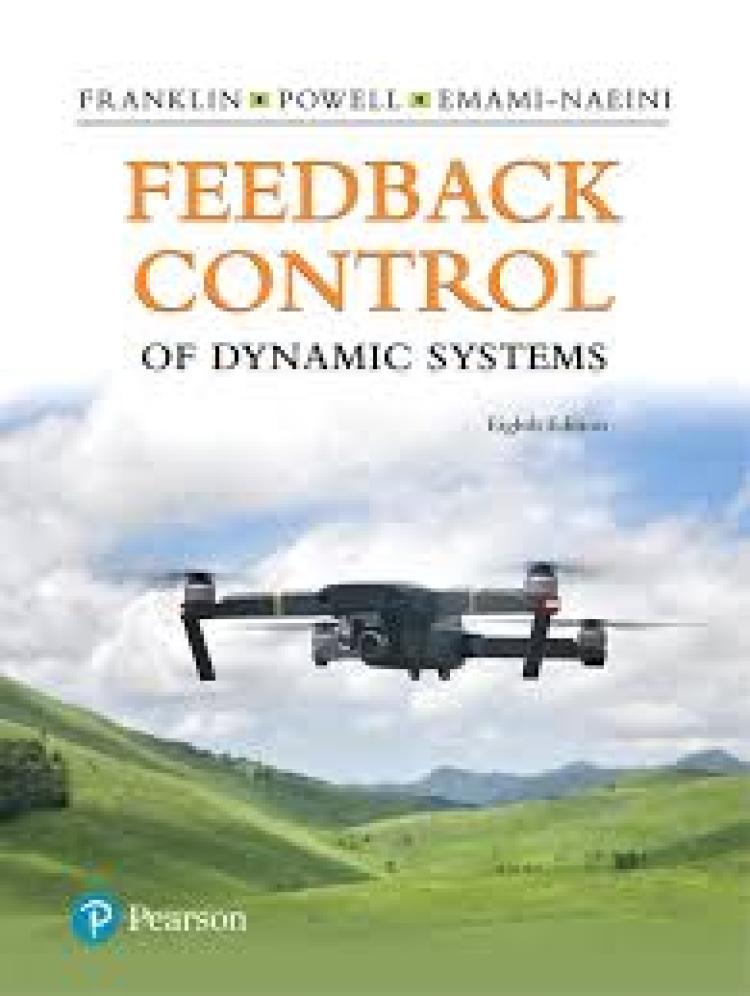
Textbook
Feedback control of Dyanmic Systems by Franklin (8th Edition)
Topics Covered
(not restricted to this order but will following closely)
- Modelling
- Systems of Differential Equations
- Numerical Simulations via Simulink and Matlab
- Deriving Equations of Motion (EOM) for Mechanical Systems
- Deriving Equations of EOM for Electrical Systems
- Response
- Laplace Transform
- Transfer-Function
- Block-Diagrams
- Time-Domain Performance
- Stability
- Intro to Feedback
- Tracking/Rejection/Sensitivity
- Steady-State Error
- PID Control
- Root-Locus Design
- Sketching Rules
- Lead/Lag Compensators
- Notch Compensator
- PID
- Frequency-Domain Design
- Bode
- Nyquist
- Margins
- Close-Loop Performance
- PD/Lead/Lag
- Robustness
- Intro to State-Space
Grading Breakdowns
- Individual Work (100%)
- Midterm Exam (35%) on March 10th from 3:30-5:30pm
- Final Exam (40%)
- Homework (25%)
Office Hours
Dr. Ruben: Tu 5 - 6pm; Wed 1:15 - 2:15pm; both in the ME community room, which is just outside my office. Or if office hours are not busy, I'll be in my office (ECME 128) and you can come grab me.
Ivan: Mon 12:30 - 2:30pm in the ME community room.
Mateo: Tue 2-3pm in ECNW 148; Tue 6-7pm in the ME community room
Jordan: Wed 2:15 - 3:15 in the ME community room; Thu 11am - noon in the ME community room.
Canvas
To access the following material, you must log in to Canvas:
- Homework Assignments
- Homework Solutions
- Exam Solutions
Policies
Homework
- Assignments must be neat, organized and legible. Typed assignments are welcome.
- Put a box around all final answers.
- Show your work enough to fully demonstrate your understating and your arrival at your answer.
- It is your responsibility to review the solutions to compare to your work.
- DUE DATE: Each homework is due at 3pm on Fridays to Gradescope (unless otherwise stated).
Communication
Questions about the material of the course is welcome and appreciated in lecture... please ask questions during lecture. If you have HW specific questions, please see the TAs or myself during office hours. If you have any other questions or concerns, please see me after class to chat in person. I prefer in-person communication, over email, and your questions will be answered more quickly in this manner. To be clear, talking to me after class or in office hours should be your first line of communication before sending me an email.
Grading
- You only have TWO WEEKS to question grading from the time the homework\exam is returned.
- Specificially for exam grade questions, students must write up a detailed document (using Word or other word processing tool, not hand-written) describing the question, staple it to the original exam, and give it to the professor.
- This will be the final grading scale used for the course. There is no curve. You are not competing against classmates, so help them out if you can! I reserve the right to lower the scale (i.e., make it easier), but I will not raise it.
- A: 90+
- A-:87-89
- B+:85-86
- B : 83-84
- B-:80-82
- C+:77-79
- C : 74-76
- C-:70-73
- D+:68-69
- D : 63-67
- D-:60-62
- F : 59 or below
In-Class Expectations
The following expectations will assist us with the creation of a learning community and a high quality of educational experience. The University of Colorado Classroom Behavior Policy will compliment these expectations:
- No cell phones (unless we are using them for some reason)
- No laptops (unless approved for taking notes or we are using them for some reason)
Academic Integrity
You are expected to abide by The University of Colorado Honor Code at all times.
Late Work
No late work will be accepted