Dethe, Tejas - Princeton University
Pattern Formation for Tunable Functionality in Soft Matter
Pattern formation as a result of spontaneous symmetry breaking, not only can mediate biological function but also be harnessed to create novel materials. Our work focuses on two different systems – elastic phononic crystals and phase-separating flows – to elucidate how patterns arising in soft matter can be used to create functional materials.
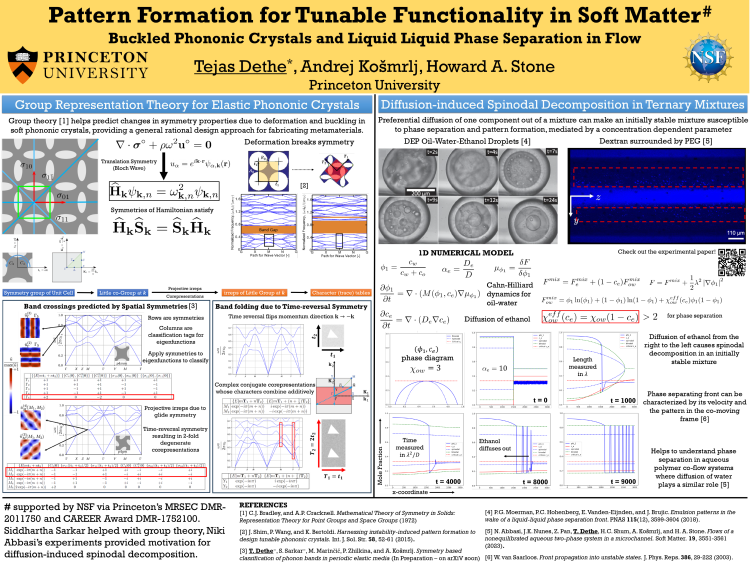
Elastic phononic crystals are soft, deformable metamaterials that have periodic modulations in their material properties, which are used to control the propagation of acoustic waves for applications such as filtering and wave-guiding. The wave propagation properties of phononic crystals, represented via band diagrams, are not only affected by material properties, but also by the symmetry properties of the crystal. These properties can influence the formation of directional as well as complete band gaps. We have developed a group representation-based framework to explain the effects of unit cell symmetries in the band diagram for undeformed elastic phononic crystals. We are now extending the group theoretic framework to account for symmetry-breaking bifurcated patterns in deformable crystals caused by buckling. This generalized symmetry-based analysis can be used to formulate rational design rules for acoustic metamaterials as well as to study generalized problems in soft matter physics via group-theoretic considerations.
Phase-separating flows, on the other hand, can lead to patterns based on nonequilibrium thermodynamics. These patterns can be used to create multilayered multicomponent droplets, as has been shown by previous researchers in Oil-Water-Ethanol systems. We study the problem of phase separation caused by the selective diffusion of one component (ethanol) out of a ternary mixture, making the mixture unstable to perturbations that lead to spinodal decomposition. In a simplified 1D Flory-Huggins type model with Cahn-Hilliard kinetics, we see the emergence of a concentration-dependent interaction parameter that guides which spatial regions of the ternary mixture have the potential to undergo phase separation. We are now characterizing the properties of an associated phase separating front, by exploring the front velocity and spectral properties of the patterns created. Our analysis can then be used to study phase separation in microchannel co-flow systems, which can help design material fibers or droplets by controlling the underlying pattern-forming phase separation processes.