

Research
- Equation Discovery
- Parameter Estimation
- Uncertainty and Identifiability
- Test Functions and Theory
- Coarse Graining
- Reduced-Order Modeling
- Control
- Applications in Biology and Ecology
- Applications in the Physical Sciences
Equation Discovery

WSINDy (Weak-form Sparse Identification of Nonlinear Dynamics) identifies governing equations from noisy data by combining sparse regression with the weak form. Integration against smooth test functions replaces derivatives of the data, making the method robust to noise and efficient for both ODEs and PDEs.
Selected papers:
- Messenger & Bortz, Weak SINDy: Galerkin-based data-driven model selection, Multiscale Model. Simul. (2021). doi:10.1137/20M1343166
- Messenger & Bortz, Weak SINDy for partial differential equations, J. Comput. Phys. (2021). doi:10.1016/j.jcp.2021.110525
- Lyons, Dukic & Bortz, Learning structured population models from data with WSINDy, PLOS Comput. Biol. (2025). doi:10.1371/journal.pcbi.1013742
Parameter Estimation
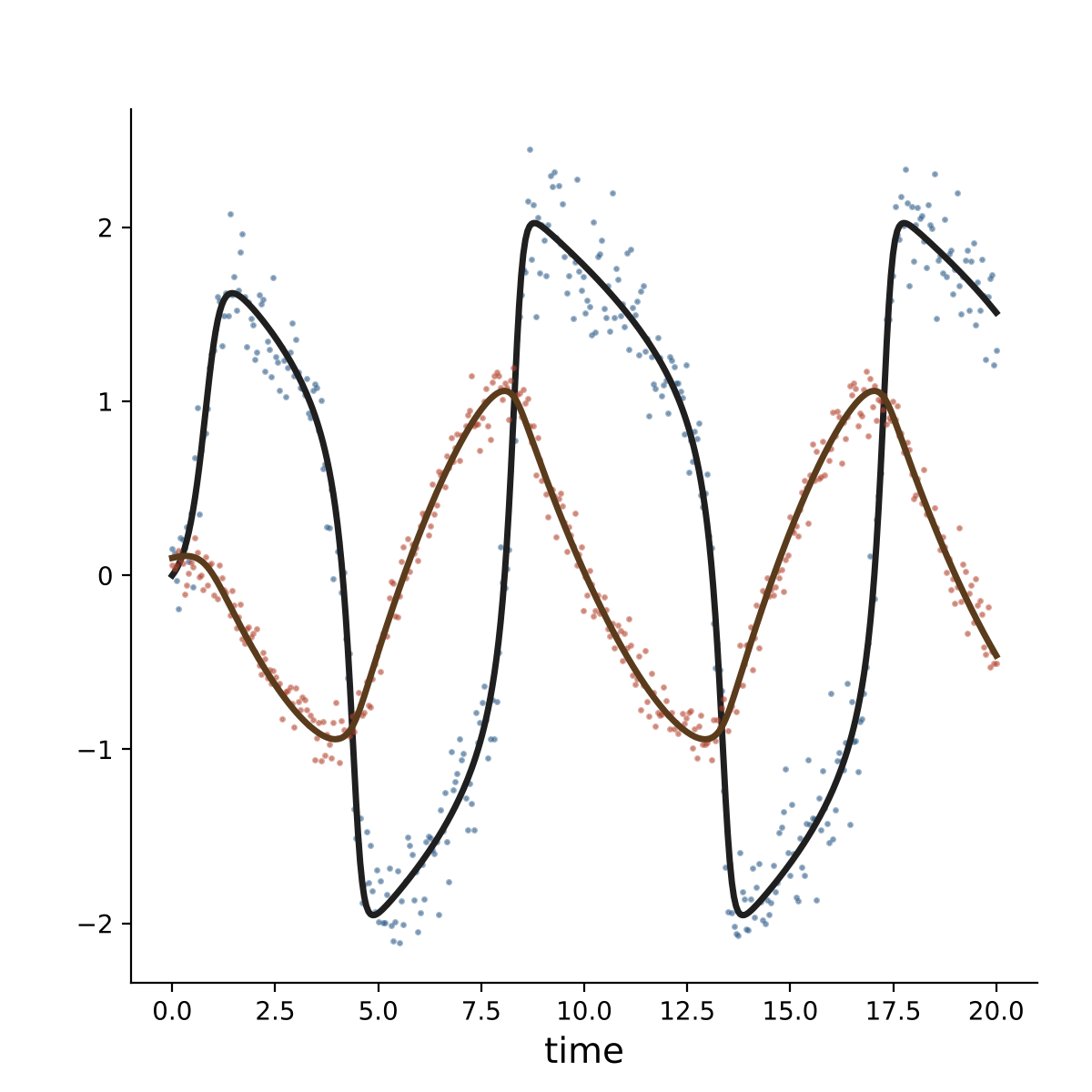
WENDy (Weak-form Estimation of Nonlinear Dynamics) estimates parameters in differential equation models without repeatedly solving them. By pairing orthonormal test functions with an errors-in-variables statistical model, it is often faster and more accurate than solver-based approaches.
Selected papers:
- Bortz, Messenger & Dukic, Direct estimation of parameters in ODE models using WENDy, Bull. Math. Biol. (2023). doi:10.1007/s11538-023-01208-6
- Rummel, Messenger, Becker, Dukic & Bortz, WENDy for nonlinear-in-parameters ODEs, SIAM J. Sci. Comput. (to appear). arXiv:2502.08881
- Messenger, Dwyer & Dukic, Weak-form inference for hybrid dynamical systems in ecology, J. R. Soc. Interface (2024). doi:10.1098/rsif.2024.0376
Uncertainty and Identifiability

Statistical properties of weak-form estimators, including bias, confidence interval coverage, and whether model parameters can be identified from the available data.
Selected papers:
- Heitzman-Breen, Dukic & Bortz, A practical identifiability criterion leveraging weak-form parameter estimation, Bull. Math. Biol. (2026). doi:10.1007/s11538-026-01639-x
- Chawla, Bortz & Dukic, Bias and coverage properties of the WENDy-IRLS algorithm, in Handbook of Visual, Experimental and Computational Mathematics (2026). doi:10.1007/978-3-032-16368-4_86
Test Functions and Theory
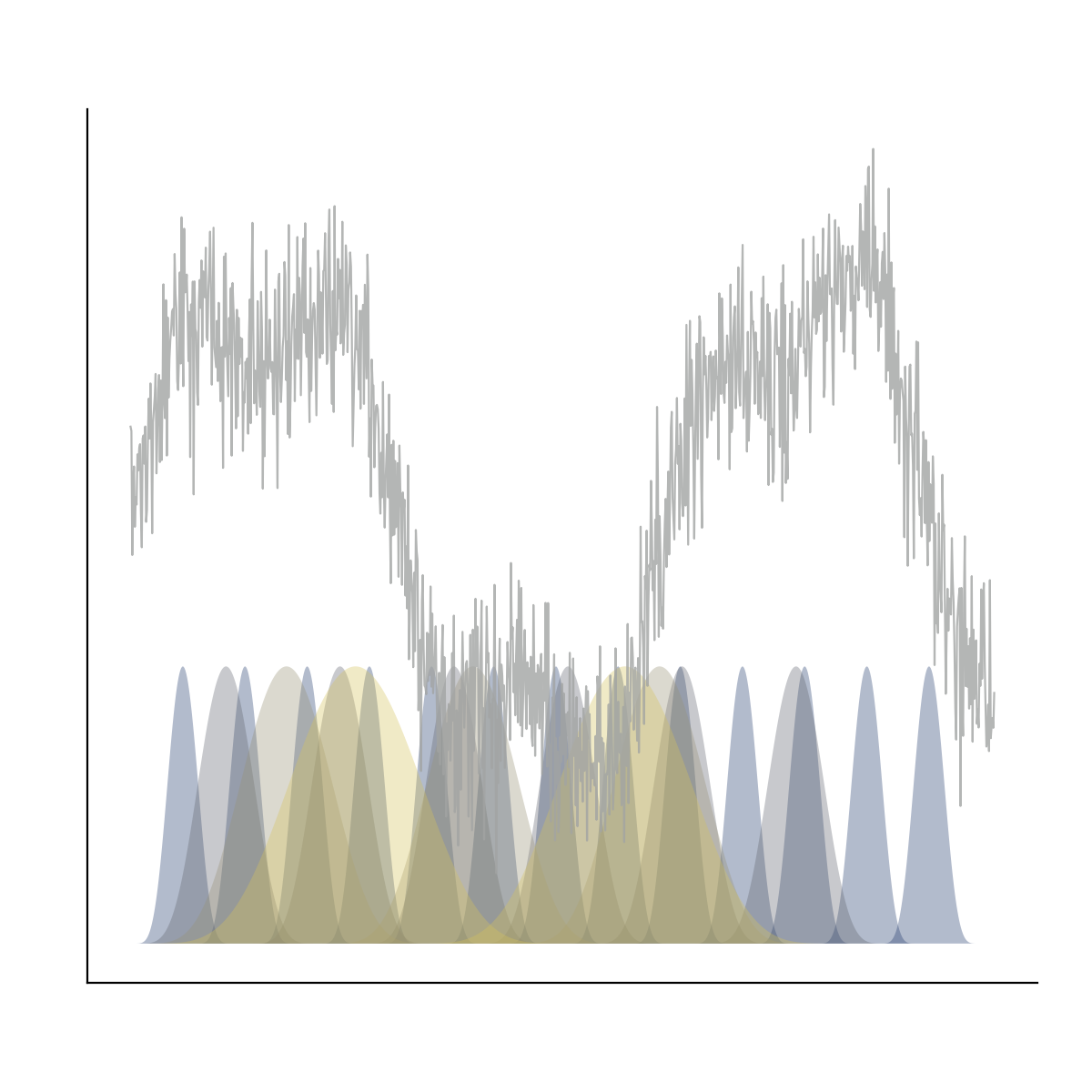
Principled construction of test functions, and the conditions under which weak-form estimators are consistent.
Selected papers:
- Messenger & Bortz, Asymptotic consistency of the WSINDy algorithm in the limit of continuum data, IMA J. Numer. Anal. (2025). doi:10.1093/imanum/drae086
- Tran & Bortz, Weak form scientific machine learning: test function construction for system identification, SIAM J. Sci. Comput. (2026). doi:10.1137/25M1776020
Coarse Graining
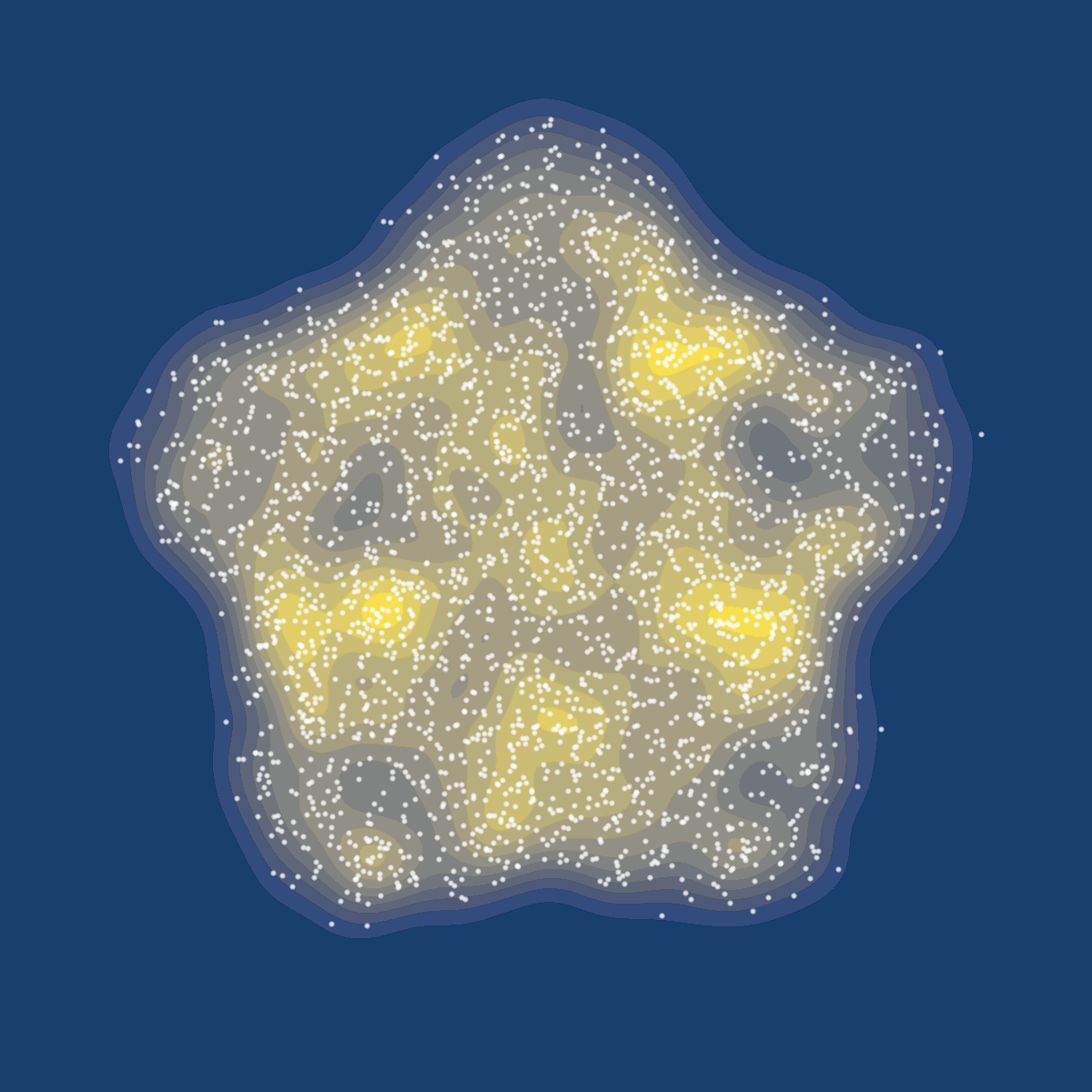
Weak-form learning recovers effective models at coarser scales, such as mean-field equations from particle data and reduced Hamiltonian systems.
Selected papers:
- Messenger & Bortz, Learning mean-field equations from particle data using WSINDy, Physica D (2022). doi:10.1016/j.physd.2022.133406
- Messenger, Burby & Bortz, Coarse-graining Hamiltonian systems using WSINDy, Sci. Rep. (2024). doi:10.1038/s41598-024-64730-0
Reduced-Order Modeling

Combining weak-form learning with latent space dynamics identification yields fast, noise-robust surrogate models of expensive simulations.
Selected papers:
- Tran, He, Messenger, Choi & Bortz, Weak-form latent space dynamics identification, Comput. Methods Appl. Mech. Eng. (2024). doi:10.1016/j.cma.2024.116998
- He, Tran, Bortz & Choi, Physics-informed active learning with simultaneous weak-form latent space dynamics identification, Int. J. Numer. Methods Eng. (2025). doi:10.1002/nme.7634
Control
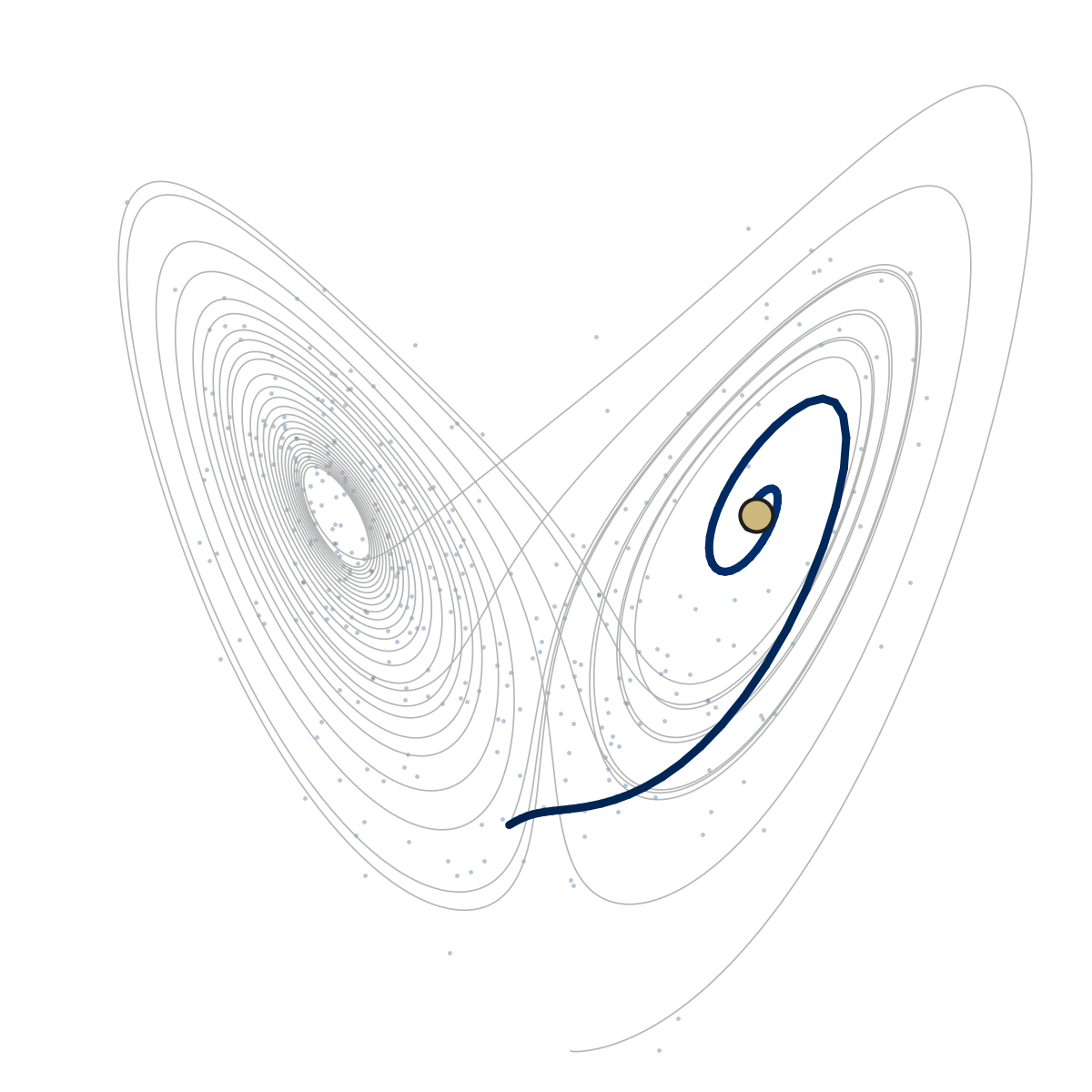
Models learned with WSINDy serve as the predictive model in model predictive control, with applications to fusion, drones, and chaotic systems.
Selected papers:
- López, Partridge, De Pascuale, Lore, Christlieb, Becker & Bortz, WSINDy for model predictive control with applications to fusion, drones, and chaos, Proc. R. Soc. A (2026). doi:10.1098/rspa.2026.0413
Applications in Biology and Ecology

Applications include insect outbreaks and movement, cell interactions, structured populations, and dynamics on networks.
Selected papers:
- Minor, Elderd, Van Allen, Bortz & Dukic, Weak-form learning for mean-field partial differential equations: an application to insect movement, SIAM J. Life Sci. (2026). doi:10.1137/25M1812038
- Messenger, Dwyer & Dukic, Weak-form inference for hybrid dynamical systems in ecology, J. R. Soc. Interface (2024). doi:10.1098/rsif.2024.0376
- Messenger, Wheeler, Liu & Bortz, Learning anisotropic interaction rules from individual trajectories in a heterogeneous cellular population, J. R. Soc. Interface (2022). doi:10.1098/rsif.2022.0412
- Lyons, Dukic & Bortz, Learning structured population models from data with WSINDy, PLOS Comput. Biol. (2025). doi:10.1371/journal.pcbi.1013742
- Tian, Messenger, Dukic, Rodríguez & Bortz, Learning effective models from network dynamics data with multiple initial conditions using weak form SINDy, preprint (2026). arXiv:2605.30432
Applications in the Physical Sciences
Applications include atmospheric models learned from turbulent simulations and weather data, magnetized plasmas and MHD, and ultracold gases.
Selected papers:
- Minor, Messenger, Dukic & Bortz, Learning physically interpretable atmospheric models from data with WSINDy, J. Geophys. Res. Mach. Learn. Comput. (2025). doi:10.1029/2025JH000602 · arXiv:2501.00738 · Eos Research Spotlight
- Burby, Maldonado, Ruth, Messenger & Carbajal, Nonperturbative guiding center model for magnetized plasmas, Phys. Rev. Lett. (2025). doi:10.1103/PhysRevLett.134.175101
- Vasey, Messenger, Bortz, Christlieb & O’Shea, Influence of initial conditions on data-driven model identification and information entropy for ideal MHD problems, J. Comput. Phys. (2025). doi:10.1016/j.jcp.2025.113719
- Wang & Messenger, Physics-guided weak-form discovery of reduced-order models for trapped ultracold hydrodynamics, Phys. Rev. A (2025). doi:10.1103/PhysRevA.111.033311
A full list is on the Publications page.