

|
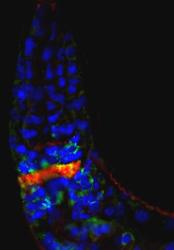
Expression of human beta-amyloid peptide (green)
in nerve ring (red) of transgenic C. elegans worm
(cell nuclei in blue) |
 |
Molecular Biology of Neurodegeneration Laboratory
Institute of Behavioral Genetics
Life Sciences Research Bldg #4
Department of Integrative Physiology
University of Colorado
Boulder, CO 80309-0447
phone: 303-735-5112
fax: 303-492-8063 |
Research Interests
Our laboratory uses the simple nematode worm Caenorhabditis elegans to study the basic biology of human neurodegenerative diseases, including Alzeheimer's Disease (AD). The key assumptions are that some of the molecular and cellular events underlying neurodegenerative pathology are likely to occur even in a simple metazoan such as C. elegans, and the experimental advantages of this model system will simplify understanding these events. Our general approach is to: 1) construct transgenic C. elegans animals expressing human proteins causally associated with neurodegenerative diseases, 2) determine the resulting physiological effects, 3) seek to determine the molecular basis of these effects, and 4) extend these insights to mammalian models and the human disease itself.
Personnel
- Director: Christopher D. Link, Ph.D.
- Doctoral Student: Tassa Saldi.
- Professional Research Assistants: Gin Fonte, Christime M. Roberts, Vishantie Sudama.
- Undergraduate Students: Patrick Kenneth Gonzales, Emily M. Martersteck, Sharanya Thummalapally, Tianyi Lu.
- Collaborators: Gretchen Stein, University of Colorado, Boulder; Leonard Petrucelli, Mayo Clinic; Yuan Luo; University of Maryland; David Sattelle, Universiity of Oxford; Nikos Robakis and Chrales Mobbs, Mt Sinai Medical School; Antonio Miranda Vizuete, Universidad Pablo de Olavide.
|
| Link Lab (circa 2008) |
Current Research Projects
- Transgenic C. elegans as Amyloid Disease Model. The goal of this project is to understand the cellular and molecular basis of β-amyloid peptide (Aβ) toxicity using genetic and molecular genetic analysis of transgenic C. elegans animals expressing the human Aβ peptide.
- Investigation of TDP-43 Function and Toxicity in C. elegans.
The goal of this project is to use both transgenic C. elegans strains and cell culture models to investigate both the function and toxic mechanism of TDP-43, a recently identified protein that has been causally linked to Amyotropic Lateral Sclerosis (ALS) and other neurodegenerative diseases.
- Structure/function analysis of in vivo beta amyloid peptide toxicity.
This project proposes contruction of transgenic C. elegans strains expressing single amino acid variants of the human beta amyloid peptide. These studies will test models of the structure of the toxic beta amyloid species.
Funding
- 2008-2012, NIH R01 AG012423-12, "Transgenic C. elegans as Amyloid Disease Model".
- 2009-2013, NIH R01 NS063964-01, HHS/NINDS, HHS/NIA, "Investigation of TDP-43 Function and Toxicity in C. elegans".
- 2007-2009, Alzheimer's Association Zenith Award, "Structure/function analysis of in vivo beta amyloid peptide toxicity".
Recent Publications
- Hassan, WM, Merin, DA, Fonte V, Link, CD. AIP-1 ameliorates β-amyloid peptide toxicity in a Caenorhabditis elegans Alzheimer's disease model. Human Molecular Genetics May 3 [Epub ahead of print], 2009.
- Zhang YJ, Xu YF, Cook C, Gendron TF, Roettges P, Link, CD, Lin, WL, Tong J, Castanedes-Casey M, Ash P, Gass J, Rangachari V, Buratti E, Baralle F, Golde TE, Dickson DW, Petrucelli L. Aberrant cleavage of TDP-43 enhances aggregation and cellular toxicity. Proceedings of the National Academy of Sciences of the USA May 5;106(18):7607-12, 2009.
- Fonte V, Kipp DR, Yerg J, Merin D, Forrestal M, Wagner E, Link CD. Suppression of in vivo β amyloid peptide toxicity by overexpression of the HSP-16 small chaperone protein. Journal of Biological Chemistry 283(2): 784-91, 2008.
- Link, CD, Fonte V, Roberts CM, Hiester B, Silverman MA, Stein G. The β amyloid peptide can act as a modular aggregation domain. Neurobiology of Disease 32(3):420-5, 2008.
- Florez-McClure ML, Fonte G, Hohsfield L, Bealor M, Link CD. Decreased insulin signaling promotes the autophagic degradation of β-amyloid peptide in C. elegans. Autophagy 3(6): 569-80, 2007.
- Boyd-Kimball D, Poon HF, Lynn BC, Cai J, Pierce Jr WM, Klein JB, Ferguson J, Link CD, Butterfield DA. Proteomic identification of proteins specifically oxidized in Caenorhabditis elegans expressing human Abeta(1-42): Implications for Alzheimer's disease. Neurobiology of Aging 27(9): 1239-49, 2006.
- Link CD. C. elegans models of age-associated neurodegenerative diseases: Lessons from transgenic worm models of Alzheimer's disease. Experimental Gerontology 41(10): 1007-13, 2006.
- Link CD, Fonte V, Hiester B, Yerg J, Ferguson J, Csontos S, Silverman MA, Stein GH. Conversion of Green Fluorescent Protein into a Toxic, Aggregation-prone Protein by C-terminal Addition of a Short Peptide. Journal of Biological Chemistry Jan 20;281(3):1808-16, 2006.
- Wu Y, Wu Z, Butko P, Christeen Y, Lambert, MP, Klein WL, Link CD, Luo Y. Aβ-induced pathological behaviors are suppressed by Ginkgo biloba extract and ginkgolides in transgenic Caenorhabditis elegans. Journal of Neuroscience 26(50):13102-13, 2006.
|
 |