


Jack Schall
- IRES 2025 Participant
- Graduate Student
- NATIONAL LABORATORY OF THE ROCKIES
- COLORADO SCHOOL OF MINES
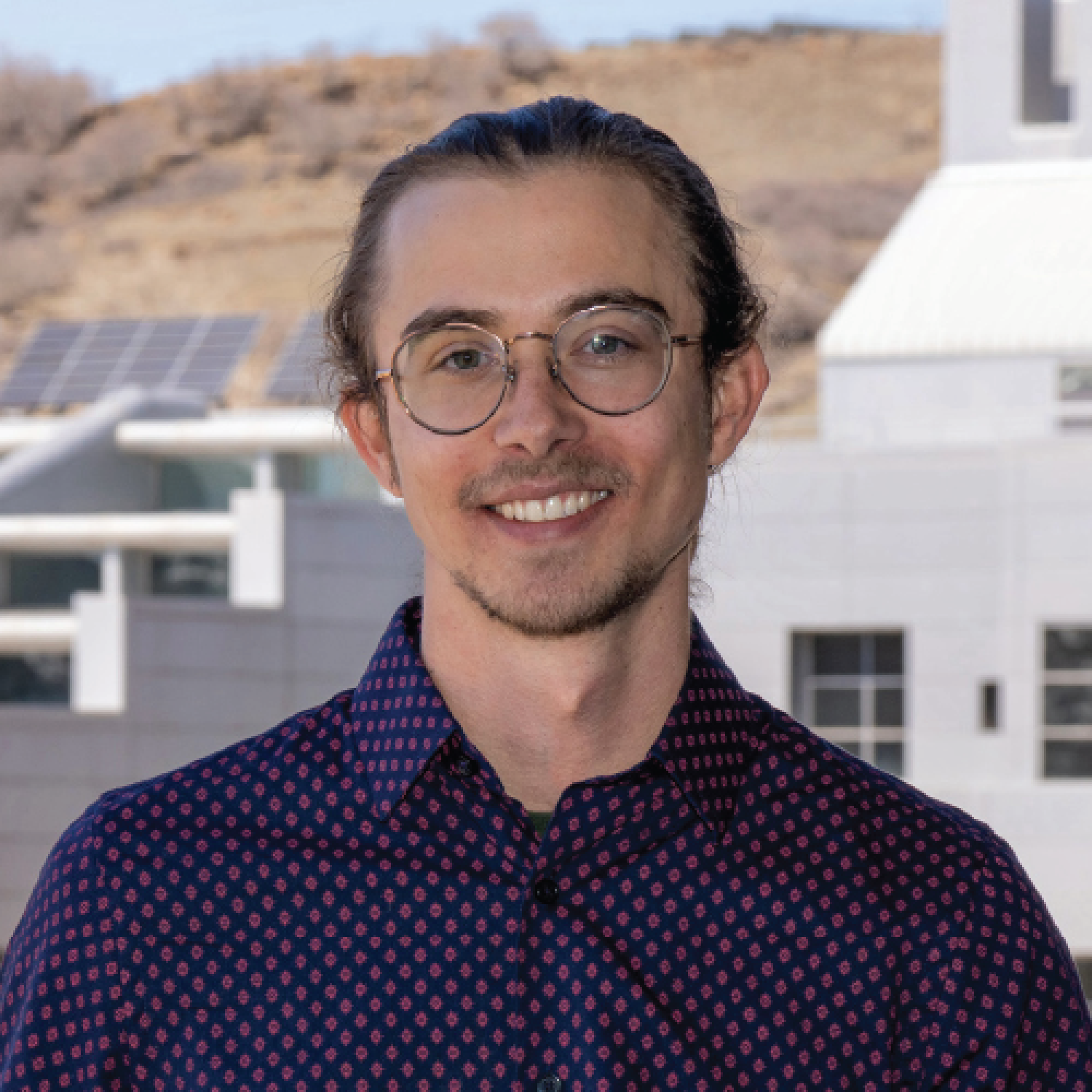
Jackson Schall is a Ph.D. student at the Colorado School of Mines, conducting his research at the National Renewable Energy Laboratory (NREL). His work focuses on advanced imaging techniques, including electroluminescence, photoluminescence, and thermography, to investigate metastabilities in perovskite solar cells and evaluate overall device quality. His research aims to advance characterization methods for perovskite materials, enabling rapid measurement and assessment of next-generation photovoltaic technologies.
As part of his doctoral training, Jackson was selected for the Colorado Science and Engineering Policy Fellowship, where he collaborated with state legislators and policymakers to explore the intersection of energy technologies and public policy. This experience broadened his perspective on how scientific research can inform and shape sustainable energy strategies at the policy level.
Before joining NREL, Jackson earned a B.S. in Physics from the University of Toledo. He completed research appointments at Brookhaven National Laboratory, CERN, and the University of Salford in the UK, where he gained early exposure to international collaboration and cutting-edge experimental physics.
Jackson is passionate about bridging fundamental research with real-world energy solutions and contributing to the global transition toward renewable energy generation and storage.
Graduate Advisor: Dana Kern (NREL)
IRES-Perovskites Host: Eva Unger (Helmholtz Zentrum Berlin)
Imaging Metastability in Perovskite PV
This project investigates the metastable optoelectronic behavior of perovskite photovoltaic devices under cyclic light stress. The original aim was to use temperature-dependent, in-situ photoluminescence (PL) imaging and spectroscopy with the newly commissioned Open Instruments LUMIKON Max tool to study transient effects during light cycling. However, due to a hardware failure in the optical head, full PL-based experiments were postponed until after the fellowship. In response, I pivoted toward two productive outcomes: (1) producing thermal characterization results for encapsulated devices under illumination, and (2) developing a data analysis pipeline to extract insights from a large body of existing time-evolving electroluminescence and PL imaging data collected from the PACT project. This work lays the foundation for future temperature-controlled metastability studies and provides early progress toward clustering-based image analysis for long-term perovskite module stability.