

Corinth

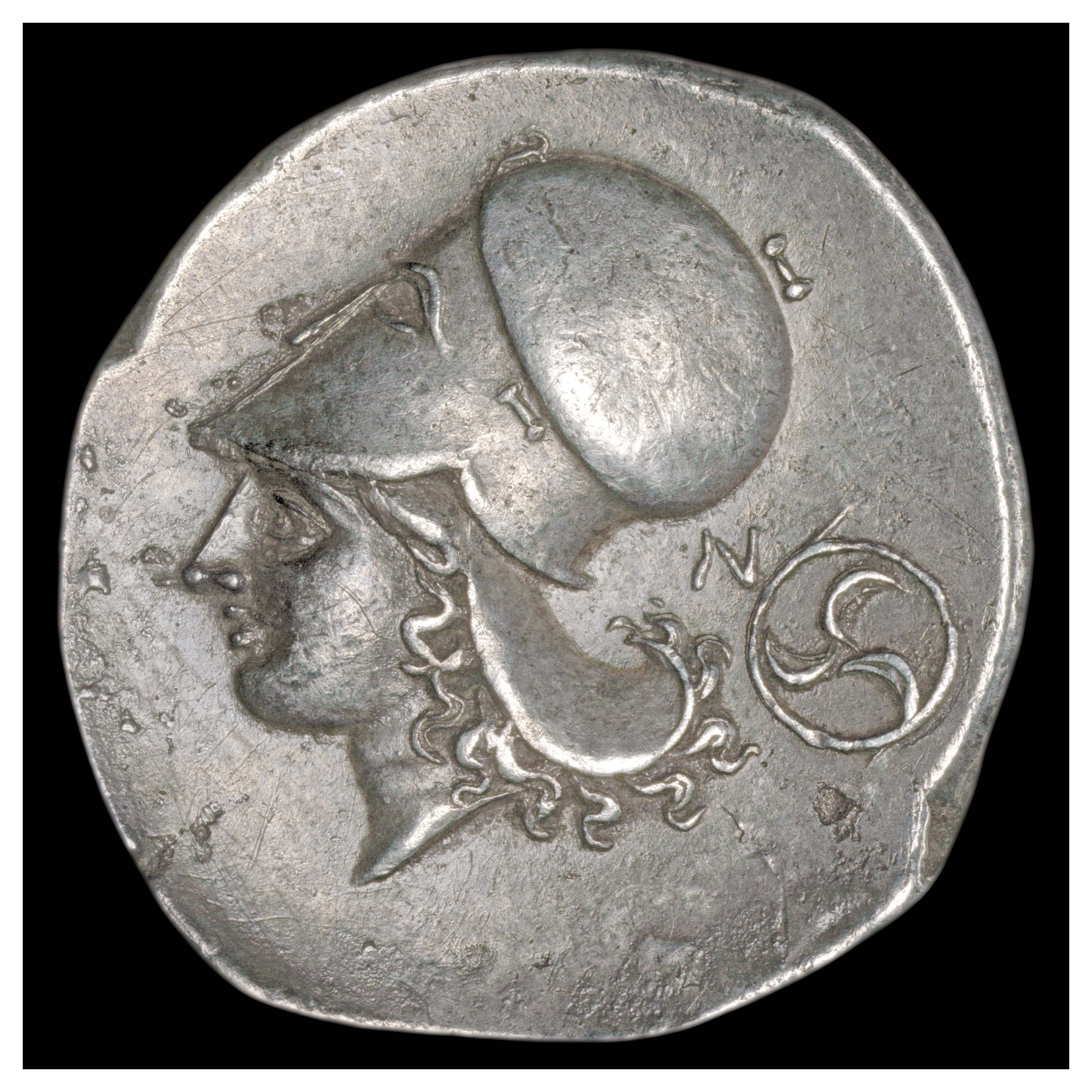
Figure 1. Silver Stater, Corinth, 350-338 BCE (On loan to CU Art Museum, courtesy of John Nebel)
Historical Overview
Ancient Corinth was located on the Isthmus of Corinth connecting the northeastern Peloponnese with the Greek mainland. The city was named after its historical founder, Corinthus, the son of Pelops.

Figure 2. Silver Stater, Corinth, 550-500 BCE. CUAM 2014.06.135.

Corinthian coinage was struck from the mid-6th century to the early 3rd century BCE; it became an “international” currency, like the coinage of Athens and Aegina (Davis 1967, 36). Early silver Corinthian coinage, for instance, a silver stater (Fig. 2) in the CU Art Museum's collection (2014.06.135), shows Pegasus on the obverse and a geometric “swastika” motif or tetraskeles on the reverse.
Pegasus is the child of the Gorgon, who was born when the Greek hero, Perseus, decapitated her. In local Corinthian mythology, Pegasus was captured while drinking at the fountain of Peirene by Bellerophon with the help of Athena’s gift to him: a magic bridle (Davis 1967, 36). By the late 6th century BCE, the helmeted head of Athena appeared on the reverse, representing Athena Chalinitis (“the bridler”) who was worshiped at Corinth in relation to this local myth (Davis 1967, No. 4, p. 36).
Corinthian Silver Coinage
The first series of Corinthian silver coinage was minted from 570/560 BCE to around 515/510 BCE (Kraay 1976, 79-80). The silver stater (Fig. 2) in the CUAM’s collection (2014.06.135) depicts Pegasus, striding to the left, with curled wings. Pegasus symbolizes the Corinthian’s local mythological narrative about their local hero Bellerophon, the son of the king of Corinth, Glaukos, who after being gifted a bridle by Athena, fly’s Pegasus to slay the Chimaera as one of his labors in Lycia (Ziskowski 2014; Brice & Ziskowski 2021). The archaic Doric letter “koppa”, signals its initial founding by the Dorians around 900 BCE, which is located between Pegasus’s inner legs underneath his belly (Fig. 2) (Kraay 1976, 79-82; Brice & Ziskowski 2021, 12-13). The reverse has a shallow intaglio "swastika"-like geometric design (Kraay 1976 81-82). This reverse type predates the coins with the head of helmeted Athena in profile (see CUAM 2014.06.137-138), which appear on Corinthian coins around 520/515 BCE. This date was disputed, but Kraay argues for the later date proposed here, marking is the only major iconographic change in the history of Corinthian silver coinage (Kraay 81-82).

Figure 3. Silver Drachma, Corinth, 350-306 BCE. CUAM 2014.06.142.

The iconography of Corinthian silver coinage remains the same after 520/515 BCE. However, there were stylistic changes showing more early classical features of the portrait head of Athena on the reverse after 480 BCE. A silver drachma (Fig. 3) from the CUAM's collection (2014.06.142) from the mid-4th century BCE renders Athena's face with a strong nose and heavy chin. Kraay compares the hairstyle, in which the front locks are braided and rolled around a fillet to the hairstyle of the “Kritios Boy” statue (480 BCE) (Kraay 1976, 82-83). The style of the Kritios Boy marks the transition from archaic style kouroi statues to more "realistic" early classical statues. The occurrence of the stylistic change on other artistic media, in addition to sculpture, fits into the wider art historical debate on Greek sculpture about a stylistic “evolution” or “revolution”.
Bibliography
Davis, Norman. 1967. Greek Coins & Cities. London: Spink & Son Ltd.
Fullerton, Mark. 2016. Greek Sculpture. Chichester, West Sussex : John Wiley & Sons Inc.
Kraay, Colin M. 1976. Archaic and Classical Greek Coins. London: Methuen.